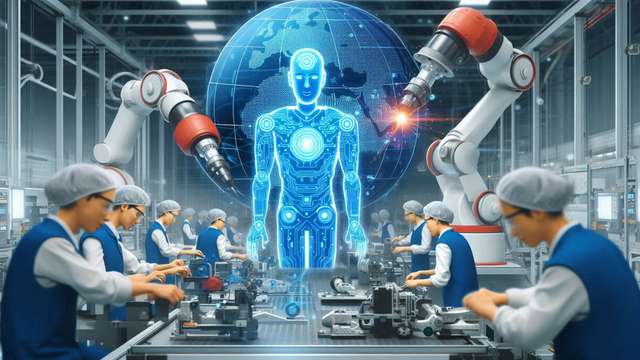
We are rushing forward without a moment to rest. The industrial world is entering an entirely new era, where advanced automation and artificial intelligence are beginning to play an increasingly important role in the transformation of manufacturing processes.
Table of content
What specifically is at stake? About Schaeffler's recent announcement that it will deploy humanoid robots in its factories by 2030. And it was this announcement that heated up the industry, as it shows emphatically where we are heading.
The future of factories
Schaeffler is a company that is known for its specialization in automotive and industrial solutions. Its idea is for humanoid robots to increasingly support humans in complex manufacturing processes.
Thanks to their advanced AI algorithms, they are able to learn on the fly, adapt to dynamic working conditions and perform tasks that require precision and flexibility - often beyond the capabilities of traditional industrial robots.
- This is not just a step toward automation, but a revolution in the way we view human-machine cooperation, said Thomas Faustmann, Schaeffler board member responsible for technology development. - Humanoid robots will make the processes in our factories more efficient, flexible and safe, he added.
AI drives innovation
It is worth noting that Schaeffler's decision is part of a global trend where AI and new technologies are changing the way industry operates. In recent years, artificial intelligence has gained prominence in data analysis, process optimization and manufacturing automation.
Companies such as Tesla, BMW and Foxconn have long used robots in their production lines, but Schaeffler's humanoid machines represent a whole new dimension of human-machine collaboration.
The use of AI in humanoid robots will enhance their ability to solve problems in real time. Thanks to machine learning algorithms, these robots will be able to analyze their actions, improve production processes and make adjustments without the need for human intervention.
- Deploying humanoid robots means not only improving production processes, but also creating a work environment that is more conducive to the integration of humans and machines. This is an example of how technology can support humans rather than replace them.” - Anna Kowalska, an expert on digital transformation in industry, added, as quoted by Modern Industry.
Challenges and risks
Despite their enormous potential, the introduction of humanoid robots brings challenges and perhaps even risks. A key issue remains their integration with existing systems and ensuring safety in the work environment. Equally important is preparing the workforce to work with advanced technology.
As Prof. Michal Nowak of the Warsaw University of Technology notes - The success of implementing such solutions depends on the parallel development of human competence. Training employees, building technological awareness and trust in machines is the key to harmonious cooperation in factories of the future, he said.
A sustainable future
Schaeffler's investment in humanoid robots is also a step toward a more sustainable industry. Modern machines not only save time and energy, but also minimize errors and waste of resources. Combined with data collected in real time, companies can make more informed decisions that contribute to environmental protection.
At a time when digital transformation has become a priority in almost every industry, initiatives such as the one proposed by Schaeffler are setting the standard for the future. Humanoid robots are not just manufacturing tools - they are a symbol of modern technological ambitions that combine innovation with humanism and social responsibility.
With its bold approach, Schaeffler inspires us to look at technology as a partner that supports us in building a better, more efficient world. In the age of AI, it is still the human being at the center - and technology is his best ally.