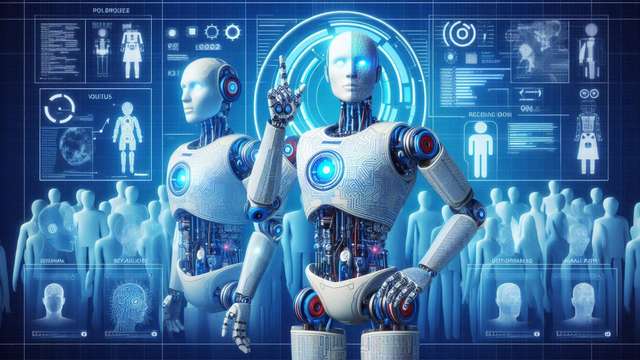
Will June 2025 be remembered in history as the time when one of the great breakthroughs in industrial automation took place? It is possible, because the development of humanoid robots is finally ceasing to be a futuristic vision known from the best science fiction books and is becoming a real alternative to traditional machines that have been supporting industry for years.
Spis treści
- Touch sensors - from subtle control to material analysis
- Navigation and perception - LiDAR and cameras go hand in hand
- Component market - from billions to tens of billions
- Industrial implementations - from testing to expansion
- Regulatory and technical challenges - from safety to standardisation
- Prospects - from ‘physical AI’ to human-robot cooperation
How do we know all this? From a special IDTechEx report, which provides forecasts for a fourteen-fold increase in the RH market over five years. What's more, leaders such as Tesla and BYD are already planning to expand the installation of humanoids in their plants more than tenfold in 2025–26, aiming to reduce their costs by around 25 per cent!
What is the reason for such dynamic growth? It is the result of several overlapping trends: a surge in investment in artificial intelligence, a breakthrough in sensor production costs, and growing expectations regarding the flexibility and adaptability of machines.
Touch sensors - from subtle control to material analysis
Humanoids without precise touch sensors are like a blindfolded person - they can pick something up, but they don't know what they are dealing with. Touch sensors integrate signals of force, pressure, torque and even slip, allowing for automatic adjustment of grip force in the context of the shape, stiffness or hardness of objects.
Although optical sensors offer the highest precision, their cost and sensitivity to external factors make them less attractive in some scenarios. Capacitive and magnetic sensors seem to be cheaper but perfectly adequate for typical applications. Flexible capacitive touch skins appear to be the most promising direction, although their design still needs to be refined in terms of humidity and temperature.
We also have a sensible application of 6D sensors on the horizon - the so-called intelligent ‘gripping tip’, which can precisely recognise the orientation of the object being gripped, significantly increasing manipulation capabilities.
Navigation and perception - LiDAR and cameras go hand in hand
In the 3D-frame industry, a factory is not just an assembly line, but also a variety of unsupervised spaces where a robot must plan its route independently. That is why humanoids require more than just cameras – they also need precise spatial perception.
Although Tesla (‘Optimus’) relies solely on camera vision, experts (such as Hesai Tech) point out that cameras alone cannot cope with difficult conditions: low light, reflections, daylight transitions - these are areas where LiDAR significantly improves reliability and safety.
LiDAR allows for rapid 3D mapping, collision avoidance and stable navigation in spaces with variable lighting, as well as in hazardous environments such as mines and tunnels. It is predicted that the combination of LiDAR + cameras, supported by AI, will become standard in industrial humanoids.
Component market - from billions to tens of billions
The value of the humanoid sensor market is estimated to reach approximately $10 billion by 2035, representing a huge opportunity for suppliers of MEMS sensors, cameras, LiDARs and encoders.
IDTechEx already points to key ‘hot spots’: the integration of sensors in non-invasive, sealed and economical modules.
At the same time, large technology companies (Apptronik, Neura Robotics, Figure AI) are conducting intensive financing rounds - Apptronik has raised $350 billion for the development of the Apollo robot, which is scheduled to debut in 2025.
Neura, on the other hand, is focusing on cognitive robots - those capable of learning and adapting - with the aim of creating the first multifunctional humanoid by the end of 2024.
Industrial implementations - from testing to expansion
Mercedes-Benz and BMW are already piloting Apptronik and Figure AI robots on their assembly lines, focusing on component handling and simple manufacturing operations.
Chinese automotive companies such as Nio and Xpeng are announcing internal implementations as early as 2025.
Startup WorkFar goes a step further by offering a ‘Robot-as-a-Service’ model - the humanoid ‘Syntro’ together with a teleoperator as a complete solution, eliminating the complexity and barriers to entry into automation through a leasing model.
Regulatory and technical challenges - from safety to standardisation
The industry faces significant challenges. Industrial RH implementations require strict compliance with EU machinery regulations (e.g. Machinery Directive 2023/1230), safety standards and certification frameworks. In addition, the integration of touch sensors, LiDARs and cameras is a complex system set-up - it requires advanced data synchronisation, real-time capabilities and redundancy.
This leads to an interesting effect: component manufacturers see enormous opportunities, but they know that without a common standard and cross-industry coordination, implementation may be delayed.
Prospects - from ‘physical AI’ to human-robot cooperation
Humanoid robots are becoming a real part of Industry 4.0 - not as a replacement for humans, but as an enhancer. There is a clear shift from autonomy to cooperative intelligence. Models such as ‘Syntro’ and Apollo combine the capabilities of AI with operator control - the robot's hand is only an arm supporting the human expert.
This hybrid approach - HRI (Human-Robot Interaction) - seems to be the most promising today, as it allows for the implementation of humanoids in the real world, while maintaining the supervision and flexibility of human action.
In the 2025–26 perspective, we are witnessing a decisive moment for humanoid robotics: cheaper and better sensors, growing R&D funding and specific pilot projects in factories are creating an ecosystem in which humanoids have a real chance of entering mass production. A key element of this ecosystem is integration - sensory, regulatory and process integration. The challenge will be to create a universal approach that will allow humanoids to operate effectively in a variety of industrial environments.
In the next decade, we are likely to see not only humanoid robots working on our production lines, but also hybrid models in which humans and machines work together to increase productivity and quality - from assembly and logistics to transport and storage. However, the key to success will be sensors - touch sensors, LiDARs and cameras - which will form the foundation for a new generation of machines. As a result, it is not the humanoid itself, but the intelligent perception and decision-making system that crosses the boundary between the laboratory and industrial worlds.