
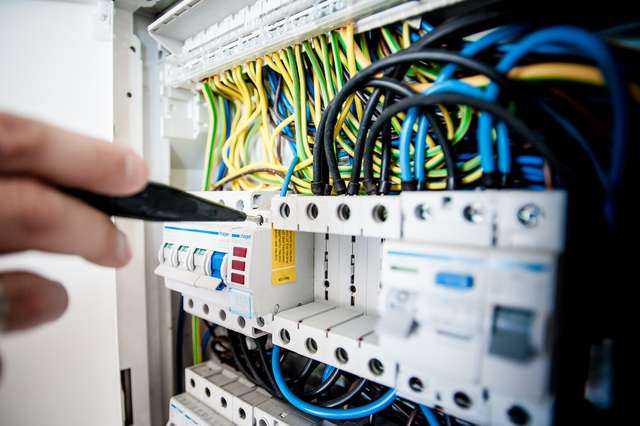
Watching sensational movies straight from Hollywood, we have often witnessed a tense scenes, when the main character wondered which cable to cut to protect himself from a bomb explosion until the last second. Blue or maybe red? These moments could remember even the greatest layman that color in the case of electric wires always matters.
Table of Contents
As with the installation of various types of devices, it is very important to describe the action plan and draw up an appropriate diagram, also the right choice of colors for individual cables is of great importance and should never be accidental. According to the norms adopted by all EU member states, there must be a kind of unification on this level.
Standard will tell the truth
The European Committee for Standardization has created the HD 308 S2: 2001 standard on the color of wires, the equivalent of which in Poland is a document called PN-HD 308 S2: 2007. This standard applies to the installation of switching systems, electrical installations or power supply of electrical receivers - mobile, but also stationary ones. Therefore, the aforementioned documents do not provide a choice and force manufacturers and suppliers of industrial automation solutions to apply specific standards.
- You should always check in the diagram which colors are assigned to what potential - said Mariusz Lenar from the Technical Garage channel cooperating with Automation Trader.
In the video below, our expert used a red cable for the positive potential and a blue one with a white stripe to the negative for connecting the wires to the 24 volt power supply. - Colors may vary slightly depending on the panel. I have already seen the use of dark blue wires for the plus and light blue cables for the minus - he added.
 Play video
The whole palette of colors
But what exactly do all these colors explain to us? What does their color tell us about industrial automation?
One of the most commonly used cables is black, which is the basis for proper marking of phase conductors in power circuits and systems. According to the standards, these are AC power circuits, but also DC power circuits.
The next color is blue, which, as our expert has already revealed, can be used to identify positive or negative DC power cables. At this point, however, it should be remembered that within one color we can deal with different shades. The light blue wire is in turn used to describe the neutral value - if there is one. If, on the other hand, you take low-voltage circuits to the workshop, you can use light blue, white-blue or even white to denote the negative power cable, which is used, for example, in the United States and Canada.
The next color we already mentioned is red. This one is by far the most used in low voltage AC circuits, but it's worth remembering that they have other uses as well. In some installations, you may encounter 24 VDC red circuits, and sometimes even data lines of this color.
Yellow-green cables with protective characteristics are also very important. This is a special case as the combination in question must not be used for other purposes. These colors are reserved for signal matters only. Interestingly, if a specific wire is to be used with green, which is generally quite arbitrary, it is recommended to change this color.
Practice and duty
Among the available colors, we can also distinguish purple, which, like green, has any application, or orange used for circuits that are live, as well as service circuits, various types of interlocks and protections.
Each of these options must be properly described and present in the diagram. It is not only a good practice, but also a duty, thanks to which it will be easier to work on a specific device. Remember that if the right colors are used, the order of the wires is important, as well as the number of wires *. It is worth being aware of this in order to avoid untidy and nervous situations, as in the aforementioned Hollywood productions, where the heroes of cinema set about saving the world and wondering until the last moment whether they will be able to cut the cable of the right color.
* - part of the cable that conducts electricity.