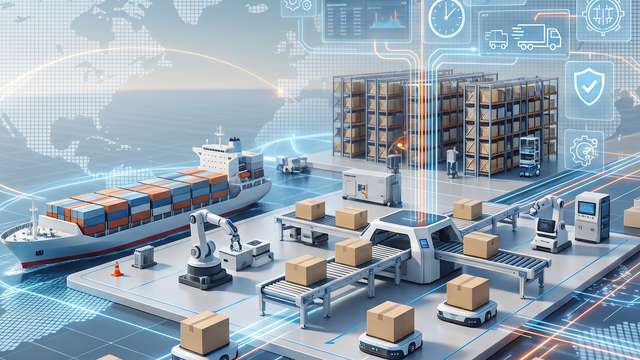

In the high-stakes world of modern manufacturing - where efficiency is measured in the millisecond cycles of a PLC and downtime in tens of thousands of pounds per hour - supply chain security has evolved. It is no longer a back-office logistical concern; it is a core engineering parameter. For decades, the automation industry was lulled into a false sense of security by the sirens of globalisation. We believed that component availability was a constant and price was the only variable. The period between 2020 and 2025 shattered that illusion, turning "cost optimisation" into a desperate fight for operational survival.
Table of content
- 1. Beyond the Invoice: The strategic reality of TCO
- 2. Critical Infrastructure: PLC, drives, and motors under pressure
- 3. The Regulatory "Squeeze": CBAM, ESG, and the UK perspective
- 4. Reshoring: The return of industrial common sense
- 5. Automation Trader: Your strategic buffer in an unpredictable world
- 6. A Roadmap to supply chain resilience
- The agile advantage
- How can Automation Trader support your resilience strategy today?
In today’s landscape of geopolitical volatility and digital upheaval, the winners are those who have grasped a brutal truth: the most expensive component in automation is the one that isn’t on your shelf when the line stops.
1. Beyond the Invoice: The strategic reality of TCO
Traditional procurement has long been haunted by the "sticker price" fallacy - focusing on the unit cost of a sensor, inverter, or motor. In the current climate, this is not just flawed; it is negligent. The true cost of a component is its Total Cost of Ownership (TCO), which must now account for a new, heavyweight factor: Risk Premium.
Consider a common scenario: An inverter sourced from East Asia sits at a 30% discount compared to a locally available unit. However, with a 12-week lead time and a volatile shipping climate, that "saving" is precarious. If a project handover is delayed or a production line sits idle for want of that single unit, the liquidated damages and lost revenue will dwarf the initial saving a hundred times over.
When you factor in rising freight costs, the necessity of "just-in-case" safety stocks, and the impending Carbon Border Adjustment Mechanism (CBAM) levies, the "cheap" offshore component often reveals itself to be the most significant financial liability on your Bill of Materials.
2. Critical Infrastructure: PLC, drives, and motors under pressure
In automation, no part is truly "minor," but certain components are the non-negotiable pillars of the system. The PLC is the brain, the inverter the nervous system, and the motor the muscle. Leaving these pillars at the mercy of a 5,000-mile supply chain is a strategic gamble that few UK businesses can afford.
- PLCs and I/O modules: The semiconductor crisis proved that the absence of a single chip can halt PLC production for months. Reliability now lies with partners who can provide immediate access to stock, refurbished units, or rapid-response alternatives.
- Variable speed drives (VSDs): As energy prices fluctuate, the VSD is a critical tool for operational efficiency. Waiting months for a replacement paralyse the very retrofitting projects designed to keep your energy bills manageable.
- Sensors and actuators: These are the front-line soldiers, most prone to mechanical wear. A Maintenance Manager doesn't need a competitive quote from overseas; they need a part at the factory gate by tomorrow morning.
3. The Regulatory "Squeeze": CBAM, ESG, and the UK perspective
The regulatory landscape is shifting toward a "European Fortress" model. The introduction of carbon reporting and cross-border adjustments means that the carbon footprint of every motor and control cabinet must soon be accounted for.
Furthermore, ESG (Environmental, Social, and Governance) criteria are no longer optional "feel-good" metrics. British manufacturers must now guarantee the ethical and sustainable origins of their components. Auditing a sprawling supply chain in the Far East is a logistical nightmare. Sourcing through a transparent, local ecosystem is the only viable way to bypass this bureaucratic and financial guillotine.
4. Reshoring: The return of industrial common sense
The UK and European markets are witnessing a massive pivot toward Nearshoring. Bringing the supply of critical automation components closer to the point of use allows for a Just-In-Time (JIT) model that actually works. By moving away from the "Big Ship" mentality, firms can reduce their dead-stock levels by up to 70%. The capital previously tied up in "safety pallets" can finally be redeployed into R&D and digital transformation.
5. Automation Trader: Your strategic buffer in an unpredictable world
In this complex environment, success requires a partner who understands that automation is not about "moving boxes" - it is about ensuring continuity of motion. Automation Trader has emerged as a vital link in this new, shortened supply chain, acting as a strategic "circuit breaker" for engineers and integrators.
When authorised distribution channels quote lead times in quarters rather than weeks, Automation Trader steps in to bridge the gap. Here is why this partnership is redefining the UK automation sector:
- Immediate physical stock: Automation Trader operates on the principle of "Real Stock, Real Time." In an era of empty promises, having a local partner with physical inventory is the ultimate shortcut in your supply chain.
- Legacy system lifecycle management: A modern supply chain must also look backward. Automation Trader excels in sourcing "obsolete" or hard-to-find components, allowing you to maintain existing lines without the eye-watering expense of a premature, full-scale PLC migration.
- Technical sovereignty: This is more than a transaction. It is about having access to specialists who can recommend an equivalent motor or drive that will get the machine running today, rather than redesigning the entire control panel around a missing part.
- Risk mitigation: By vetting and guaranteeing every component, Automation Trader provides the transparency required for modern ESG compliance, offering a level of trust that anonymous global marketplaces simply cannot match.
6. A Roadmap to supply chain resilience
If your facility is still tethered to long-distance, high-risk supply routes, consider this four-step transition:
- Criticality audit: Identify the "Single Points of Failure" in your plant. Which PLC or drive would bring your entire operation to a standstill?
- Source diversification: Move beyond the "Single OEM" mindset. Build relationships with partners like Automation Trader who can source outside of the traditional, often-congested channels.
- Localise safety stock: Transition your critical spares to a local, rapid-response model.
- Value-based procurement: Train procurement teams to evaluate "Cost per Day of Downtime" rather than just "Unit Cost."
The agile advantage
Shortening your supply chain in industrial automation is about more than just logistics - it is about Business Agility. Companies that can respond to a client’s change in concept, or a sudden hardware failure, within hours rather than weeks, will inherently dominate their sector.
The post-2025 world will not be kind to those waiting on a slow boat. In this new reality, Automation Trader is not just a supplier; we are your insurance policy against a stagnant production line. It is time to embrace the security of a shortened supply chain and the reliability of a partner who values your uptime as much as you do.
How can Automation Trader support your resilience strategy today?
- Would you like us to conduct a Spares Availability Audit for your legacy production lines?
- Do you require a Direct-Replacement Map for your most at-risk obsolete components?
- Or perhaps you would like to view our Immediate Inventory for the latest PLC and Drive series?