
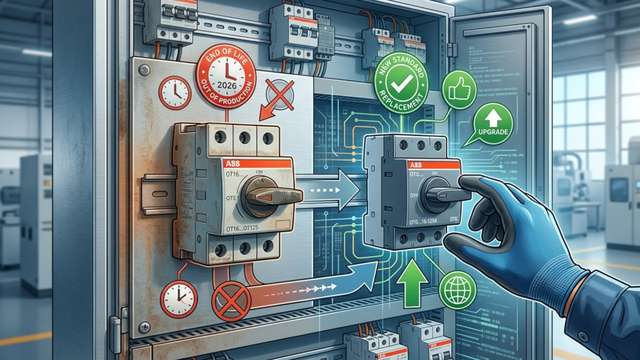
The industrial automation landscape is undergoing a quiet but significant shift. ABB, a titan in power and automation technologies, has officially confirmed that its long-standing OT series of non-fused switch-disconnectors (16A to 125A) will enter the 'Limited' phase of its lifecycle on June 1, 2026.
Table of content
For maintenance engineers and Original Equipment Manufacturers (OEMs), this marks the end of an era for a component that has been a bedrock of control cabinet design for over two decades.
This transition is not merely a footnote in a product catalogue; it represents a critical deadline for operational continuity across a vast array of industrial sectors.
1. The Critical Window: 'Last Time Buy'
With the 'Limited' phase looming, the most pressing date for procurement departments is May 31, 2026. This is the final cut-off for 'Last Time Buy' orders. Once this window closes, these units - specifically the 3 and 4-pole variants used for DIN rail and base mounting - will cease mass production.
In the industry’s Lifecycle Management (LCM) framework, the 'Limited' phase serves as a final warning. While the hardware remains reliable, the supply chain supporting it begins to dissolve. Post-June 2026, availability will be dictated by dwindling distributor stocks, and technical support will shift towards "best effort" rather than guaranteed resolution.
2. Risk Mitigation in Maintenance and Repair
The move to phase out a component as ubiquitous as the OT switch-disconnector introduces three primary layers of risk:
- Lead-Time Volatility: In the event of a failure in a legacy system, the absence of an "off-the-shelf" replacement can turn a routine repair into a weeks-long outage.
- Cost Inflation: As factory-level production ceases, the market price for remaining "new-old-stock" units typically skyrockets, often commanding a premium of 200% to 400% over original list prices.
- Documentation and Certification Hurdles: In highly regulated environments such as food and beverage or pharmaceuticals, swapping a discontinued part for a non-identical successor may require updated schematics, safety re-evaluations, or even a revision of the machine's CE/UKCA technical file.
3. Navigating the Transition: The Rise of OTG
ABB’s roadmap points clearly toward the OTG series and updated iterations of the OT range as the designated successors. However, engineers should resist the assumption that this is a simple "drop-in" replacement.
Key technical considerations for the migration include:
- Form Factor and Footprint: The newer generations are engineered for higher power density. While a smaller footprint is generally an advantage, it may require adjustments to existing wiring looms or busbar arrangements.
- Drive Systems and Handles: There is a notable shift in drive shaft specifications. Some newer models utilise a different shaft profile (e.g., a move from 6x6mm to 5x5mm in specific ranges). Consequently, replacing an older switch often necessitates replacing the external door handle to ensure mechanical compatibility.
- Thermal Efficiency: The latest iterations are designed with lower power-loss profiles, contributing to better thermal management within densely packed enclosures—a vital factor for the longevity of adjacent sensitive electronics.
4. Strategic Recommendations
For facilities managers and plant owners, a proactive stance is the only way to avoid the "obsolescence trap."
- Inventory Audit: Conduct an immediate audit of installed assets. Machines commissioned between 2010 and 2020 are the most likely candidates to be housing these soon-to-be-limited components.
- Strategic Buffer Stock: For mission-critical lines, securing a "buffer stock" before the May 2026 deadline is a low-cost insurance policy against future downtime.
- Specification Review: Ensure that all upcoming projects and tender documents are scrubbed of legacy part numbers (1SCA... codes) to prevent the installation of "end-of-life" hardware in brand-new installations.
The Broader Context
The phasing out of the legacy OT range was a recurring theme at the 2026 Hannover Messe. It reflects a broader industry-wide pivot toward "software-defined" hardware and components capable of deeper integration with energy monitoring and predictive maintenance systems. While the mechanical simplicity of the original OT series was its greatest strength, the future belongs to hardware that can talk to the cloud.
Reporting the end of support for the OT series is not about alarmism; it is about professional foresight. In an era where global supply chains remain sensitive, the ability to plan a migration two years in advance is a luxury that technical departments cannot afford to waste. Those who act now will see a seamless transition; those who wait until a switch fails in 2027 may find themselves facing a very expensive silence on the factory floor.
It is also worth noting that ABB components remain readily available through Automation Trader. We maintain extensive stock levels of essential hardware, including those parts nearing their end-of-life phase which continue to be vital for the operation of many existing production facilities.
DISCOVER THE ABB RANGE AT AUTOMATION TRADER - CLICK HERE
***
Compiled from ABB Lifecycle Management bulletins and Hannover Messe 2026 industry reports.