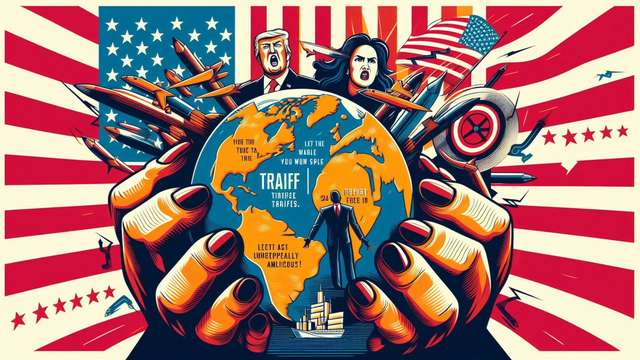
President Donald Trump's administration announced sweeping tariffs on 2 April 2025, sparking a wave of reaction around the world. Described by the president as “Liberation Day”, the decision will impose a 10 per cent tariff on all imports, with additional higher rates for selected countries.
Table of content
The move is designed to protect US industry and reduce the trade deficit, but has been met with harsh criticism from both trading partners and economic experts.
Global reactions and potential consequences
China, one of the main targets of the new tariffs, has announced that it will take ‘necessary measures’ in response to the US action. Chinese Foreign Ministry spokesperson Guo Jiakun said the tariffs ‘seriously violate WTO rules and undermine the rules-based multilateral trading system’.
The European Union has also expressed its displeasure. European Commission President Ursula von der Leyen described the tariffs as a ‘serious blow’ and announced that Europe was prepared to respond.
Japan, affected by the 25 per cent tariff on its cars, found the US decision ‘extremely regrettable’ and announced measures to obtain an exemption from the tariffs.
Impact on financial markets
The announcement of the tariffs triggered an immediate reaction in financial markets. The S&P 500 index fell by 4.9 per cent, translating into a loss of around $2.5 trillion in value. The Nasdaq fell by 5.9 per cent and the Dow Jones by 4 per cent. Analysts fear that escalating trade tensions could lead to a global recession.
Economists express serious concerns about the potential impact of new tariffs. Cullen S. Hendrix of the Peterson Institute for International Economics noted that ‘there is little evidence that tariffs will improve the US trade balance’, while highlighting the risk to millions of US workers employed in export sectors.
In contrast, Gregory Daco, chief economist at EY, predicts that the tariffs could accelerate inflation by 1 percentage point by the end of the year, pushing it up to around 4 per cent. He stresses that ‘this could be painful for many Americans, especially those with lower incomes’.
The new tariffs include a wide range of rates for different countries. China has been slapped with a 34 per cent tariff, the European Union with 20 per cent and Japan with 10 per cent. Australia and New Zealand have also been slapped with a 10 per cent tariff, which has drawn criticism from political leaders there.
What might await us?
With trade tensions rising, many countries are considering retaliatory measures. Canada has announced the possibility of imposing 25 per cent tariffs on US car imports, which could further exacerbate the trade conflict.
Experts warn that further escalation could lead to a global trade war that would negatively impact economic growth and the stability of financial markets around the world. The Organisation for Economic Co-operation and Development (OECD) has previously signalled that US tariff policies could slow global economic growth and increase inflation.
The Trump administration's decision to impose new tariffs has caused widespread repercussions internationally. While the measures are aimed at protecting US industry and reducing the trade deficit, many experts and world leaders are concerned about the negative consequences for the global economy. The coming months will be crucial to observe how the situation will unfold and what steps individual countries will take in response to US trade policies.