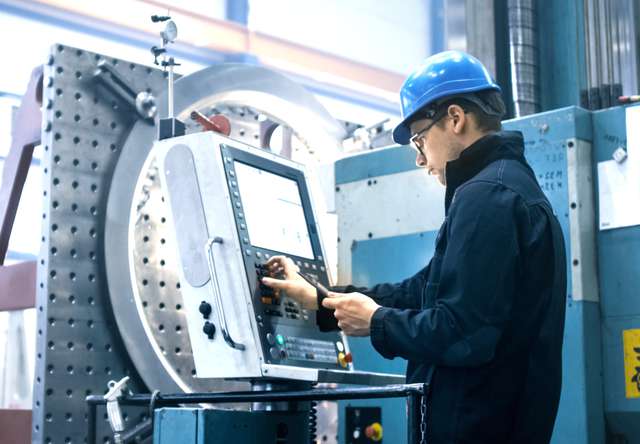
They are an integral part of installations related to industrial automation and machines that support thousands, if not millions, of various processes every day. Operator panels, because we are talking about them, are currently one of the most important elements of the production process, which enable the appropriate level of communication between the aforementioned tools and people standing in the last section of the control.
Table of Contents
During our June series, we dealt with the topic of innovation related to the industrial revolution 4.0 taking place before our eyes. One of its most important components is the high level of human and machine integration. In this case, it is about the operators who control the functioning, not only one specific machine, but also control many processes at the same time.
One panel, lots of functions
This is where the hero of our text enters the stage, i.e. the operator panel, which, thanks to its specificity, makes the work of those who use it extremely easy, and who with the development of industrial automation have more and more data to process and bear much greater responsibility on their own shoulders. Therefore, the current operator panels must meet much more stringent standards. Monochrome screens, the possibilities of which were very limited, have long become a thing of the past, although research has shown that those that offer black and white images still enjoy a certain amount of popularity on the market.
Customers whose companies are slowly moving into phase 4.0 or have been implementing new components in their production processes for a long time, expect much more and the current market does everything to meet new requirements.
It must be remembered that the HMI (Human Machine Interface) sector is not limited only to competing in terms of price. This, of course, is still a very important aspect, even a key one for many, but not the only one that is taken into account when considering various purchase options when it comes to panels. These must first of all be reliable, intuitive, allow for easy communication, and also come from a manufacturer who, apart from ordinary sales, is able to offer "something extra". This "something" is usually post-sale service at a very high level, which includes appropriate warranties and service packages. - In recent years, we have observed an emphasis not only on the functionality of the visualization, but also on the usability of operator panels. Of course, this is related to the safety of the operator and the entire production line - revealed Aleksandra Baranowska from Siemens in an interview with "Puls Biznesu”.
Size and quality
Speaking of the possibilities of visualization, it is worth stopping at this aspect for a longer time. The panel must first of all be legible, and the image quality should be at a high level. At the same time, the possibility of handling such a panel with gloves is a kind of standard, especially when it comes to places where their constant removal and putting on would be problematic or - in more extreme cases - dangerous. In this segment, manufacturers are left with no choice. Of course, they still have budget options in their offers, for less demanding customers, but ultimately, quite systematically, sales in the category of slightly higher-end equipment, i.e. those that match the standard of the aforementioned industrial revolution, which we mark with the number 4.0 .
So, since we are in 2021, the once popular operator 'cabinets' can still be seen - yes - but mainly in the industrialization museum, not in the production hall. Touch screens are already standard there, most often those with a diagonal of about 10 inches. You can also find larger ones, you can also find panel computers. The opportunities that they give to operators seem to be of key importance in the context of HMI. It is all about time and the ability to make the best decision for the production process. The system behind the panel collects all the necessary data and gives it to the human being like on a plate.

In the pursuit of innovations
Also note that HMI is not the same as SCADA. Both of these terms appear very often in the context of production processes, but they are identical. The SCADA system is a superior entity over the HMI. While the latter is usually limited to a few screens, the first one may have several dozen or even, like the Wonderware platform, several thousand under it, on the level of a very extensive database analysis and archiving service.
However, the latest technologies in the case of operator panels go a step further. More and more often you can find those that allow remote control, even from the level of ordinary smartphones. This means that the operator can control the production process in the factory, being the body in a completely different place in the world. An interesting solution also seems to be the use of virtual reality, which sneaks into various aspects of our lives in a fairly wide wave. However, while this is nothing new in the entertainment industry, in the case of the production segment it still seems to be a melody, perhaps in the near, but still future.
- The feature that is taken into account when selecting the operator panel is, above all, the possibility of integrating such a device. It is about its communication interfaces - serial, Ethernet or USB ports are very common - especially for creating a connection between peripheral devices. In industrial conditions, the quality of workmanship and the degree of protection are also important - said Patrycja Przybylska from Beckhoff Automation, a company that has a lot to offer in this sector.
Finally, we cannot forget where the given operator panel will be operated. Will it meet the requirements of a specific working environment? In some cases, basic housings and security are enough, but it happens that the standards have to be greatly increased, whether due to difficult conditions or very specific cleaning methods.
The choice in this segment of devices is currently huge. The price and reputation of the manufacturer still has a decisive influence when making a choice, but at a time when revolution 4.0 is increasingly creeping into the industrial automation industry, there are many more variables to consider.