
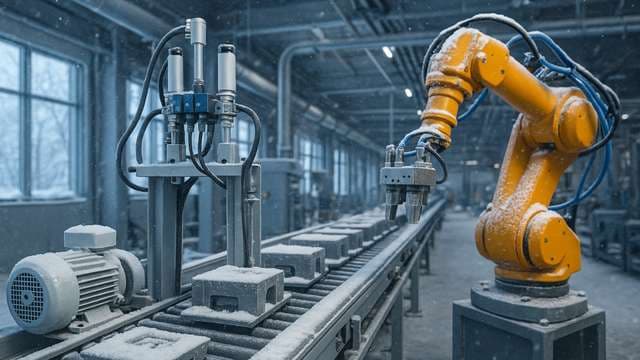
Winter months represent a heightened risk period for maintenance and production continuity. Low temperatures, increased humidity, and frequent fluctuations in power supply mean that even well-maintained production lines start to show weaknesses. In practice, every year we observe a recurring pattern of failures - and although each industry has its own specifics, certain critical points remain common. Here are the five components that fail most often in winter.
Table of content
1. Pneumatic systems
Compressed air in winter is especially prone to accumulating condensate. Water in pipes, valves, and actuators leads to corrosion, freezing, seal failures, and drops in pressure. When ambient temperatures in production halls fluctuate between shifts or if installations run through unheated zones, the problems escalate rapidly. The worst offenders are often the regulators and solenoid valves, which when operating with contaminated, moisture-laden air work excessively and may seize completely.
2. Electric motors and gearboxes
In colder months, lubricant viscosity increases, meaning higher start-up loads. For motors already operating close to their limits, even a few degrees of drop may trigger overloads, winding overheating, or excessive vibration. In gearboxes, one of two things commonly happens: early overheating in the first minutes of operation or, conversely, ‘dry’ running when the old lubricant has lost its properties. These failures typically cause downtime for conveyors, mixers, and pump units.
3. Sensor and automation systems
Low temperature and condensation of water vapour cause false signals from optical, inductive, and ultrasonic sensors. Sensitive electronic components begin to respond with delay, while moisture in junction boxes leads to intermittent communication failures. The worst-affected systems are those mounted externally or routed through zones with large temperature differences (for example, ramps or loading docks). Signal errors in an automated line often lead to stoppage of entire process chains.
4. Hydraulic systems
Though they may appear robust, hydraulics are also vulnerable in winter. Hydraulic oil thickens, filter performance drops, and proportional valves respond more slowly. If the system hasn't been pre-warmed in accordance with the procedure, the risk of cavitation and pipe rupture increases. It is particularly common in winter to see leaks in quick-connect couplings and pump failures that cannot tolerate operation with excessively viscous fluid.
5. Power supply and electrical switch-gear
Voltage fluctuations and seasonal overloads are a winter routine, especially in older plants and facilities with weak electrical infrastructure. Switch-gear rooms are often under-heated, and condensation leads to short-circuits, corrosion of contacts and failure of protective devices. The result: production lines experience random restarts, PLC errors and power dips - any of which can bring a plant to a complete halt.
How to reduce the risk?
The key is to act pre-emptively: dry and filter compressed air, perform seasonal lubricant changes, check system tightness, heat critical zones, and carry out regular tests of sensors and electrical installations. Winter does not have to be the "season of failures" - provided that the line is prepared as carefully as it would be for a new installation start-up.
A reliable partner in uncertain times
Winter failures share a common trait: they appear suddenly and mercilessly bring production to a halt. Therefore, it is essential for maintenance teams to have a partner like Automation Trader they can rely on - both for planned interventions and critical situations.
When every hour of downtime translates into losses, and obtaining the correct automation component fast is the difference between a same-day restart and full shift loss, time counts. This is especially true in winter, when failure risk rises, and working with a trusted supplier becomes not just convenient but a production-security necessity.