A cooling global economy? Supply chains still unpredictable? ESG rules in flux? All the more reason to invest in what really moves the needle on the shop floor: shorter cycles, fewer unplanned stops, stronger cyber-resilience and faster adaptation to change. The industrial winners of 2026 will be those who combine operational discipline with modular, data-driven automation - not in pilots, but in day-to-day production.
Table of content
- 1. Industrial edge AI - from cameras to operator "copilots"
- 2. Security for IACS "by design" - the 62443 mindset
- 3. Deterministic industrial networking - TSN + private 5G as the new backbone
- 4. Open, modular control - OPAF + IEC 61499 and the rise of software-defined automation
- 5. Digital twins 2.0 - from visualisation to closed-loop optimisation
- A pragmatic adoption path for 2026
- Why this matters even with ESG rules shifting
Below are five trends that are no longer "nice to have" but a strategic baseline for any forward-looking manufacturing or process plant. All of them are already in live deployments today - and all can be rolled out step-by-step with measurable ROI.
1. Industrial edge AI - from cameras to operator "copilots"
AI has left the lab and moved directly into the cell. The strongest shift at the end of 2025 is the migration of intelligence to the edge: gateways, embedded servers and even controller-class hardware next to the machine. That’s where high-frequency data actually lives - and where decisions need to be made in milliseconds.
Video analytics for quality inspection, vibration/acoustic anomaly detection or predictive maintenance - all in real time, without streaming gigabytes to the cloud. The leading reference model today is clear: IIoT → edge → AI/ML.
The well-publicised example is Hyundai’s new "AI-first" megafactory in the US, built around machine vision, autonomous inspections and a live digital twin steering decisions in the background. This is AI at scale, not another proof-of-concept.
Why it’s a must-have:
- fast ROI in scrap reduction and quality stability
- lower network/compute cost vs cloud-heavy architectures
- foundation for HMI copilots and operator decision support
2. Security for IACS "by design" - the 62443 mindset
2025 saw a major update to the ISA/IEC 62443 series, defining what an industrial cybersecurity programme should actually look like: governance, roles, risk treatment and continuous improvement — without dictating a single vendor approach. The result: a practical, auditable security baseline that doesn’t get in the way of production.
What this means for 2026 roadmaps:
- network segmentation and access policies aligned to 62443
- asset inventories and SBOMs for visibility into vulnerabilities
- anomaly detection and "assume breach" as normal practice
The business effect? Far fewer downtime incidents tied to cyber events and a smoother conversation with both insurers and customers. Without this foundation, AI, digital twins or 5G carry unnecessary risk.
3. Deterministic industrial networking - TSN + private 5G as the new backbone
The long-promised IT/OT convergence is finally materialising because the communications layer caught up. Time-Sensitive Networking (TSN) brings determinism to standard Ethernet - stable latency, time sync and priority traffic in one fabric. That’s how robots, motion control and edge AI can share a single infrastructure without vendor-lock islands.
The second pillar is private 5G, especially in its 5G Advanced (Release 18) form: higher uplink throughput, tighter reliability and extremely accurate time synchronisation. Perfect for AGVs/AMRs, mobile sensors and temporary production cells with “wired-grade” performance - but wireless.
Why it’s a must-have:
- one predictable “highway” for motion + data + AI
- easier interoperability and modular expansions
- painless plant reconfiguration while staying online
4. Open, modular control - OPAF + IEC 61499 and the rise of software-defined automation
The next leap isn’t more boxes, but decoupling control logic from hardware. The Open Process Automation Forum (OPAF) is proving, at scale, that mission-critical process plants can run on open, interoperable control components. At the same time, IEC 61499 is gaining traction as the “composable logic layer”: dynamic, portable function blocks that can be moved or orchestrated at runtime.
Plant-level payoff:
- faster projects and commissioning
- "rolling" upgrades instead of forklift replacements
- real supplier choice and longer lifecycle economics
In 2026 this philosophy - automation defined by software, not hardware - becomes the key differentiator between factories that can pivot in weeks versus those stuck in quarter-long changes.
5. Digital twins 2.0 - from visualisation to closed-loop optimisation
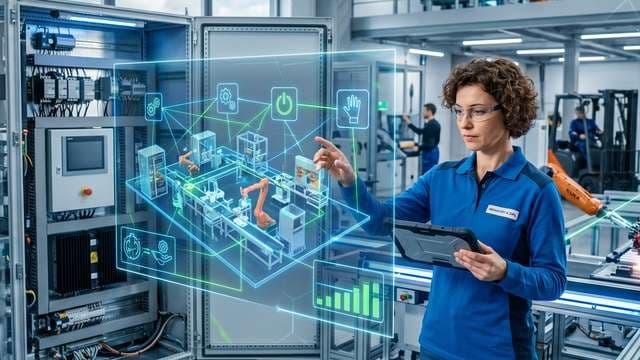
The modern twin is no longer a nice 3D model. It’s a living mirror, continuously fed by OT systems, MES, quality data and sensor telemetry - and wired into optimisation logic. It predicts, recommends and increasingly acts back on the process in a closed loop.
This is why adoption is exploding: manufacturers use the twin to validate process changes before touching the line, minimise energy and material waste, and train AI models in a safe “sandbox” before deploying them live.
Why it’s a must-have:
- faster time-to-market and painless changeovers
- real energy and material savings, not slideware
- safer experimentation and validation of AI/controls
A pragmatic adoption path for 2026
- Start with visibility and security (62443). Inventory assets, segment networks, build OT monitoring. It’s the foundation.
- Design the future-proof network. TSN for hard-real-time; private 5G for mobility and flexible capacity.
- Twin a high-impact process. Not the whole plant — pick one bottleneck line and tie insights to KPIs.
- Push AI to the edge. Start with vision inspection/predictive maintenance, then pair with an operator copilot.
- Go modular on new builds. Adopt OPAF/IEC 61499 now to avoid tomorrow’s lock-in and forklift upgrades.
Why this matters even with ESG rules shifting
Yes, parts of the EU ESG package have been delayed or softened, but customers are still demanding energy data, traceability and credible evidence of process efficiency. These five technologies provide exactly that - and cut OPEX at the same time. ESG becomes a by-product of better automation, not a separate compliance burden.
If you adopt only a few initiatives in 2026 - make them these five. They deliver visible results quickly while laying the long-term foundation for productivity, resilience and competitiveness.