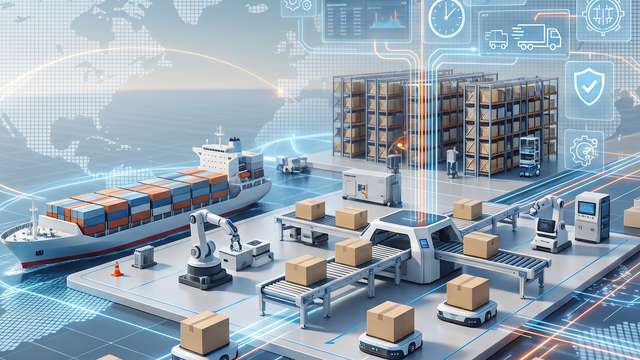
In 2026, automation is no longer about adding speed to a single machine - it’s about building systems that can adapt. Manufacturers are shifting their attention from cycle time to reaction time: how quickly a plant can reconfigure a line, respond to a quality drift, or launch a new product without a major shutdown. AI and modularity are becoming the default foundations of modern production architecture.
Table of content
- 1. From dashboards to decision-making AI
- 2. Production lines built to be rearranged
- 3. Data as an operational tool, not a reporting artifact
- 4. Robots as dynamic capacity buffers
- 5. Platform-based automation replaces “Frankenstein” solutions
- 6. Cybersecurity becomes part of the specification, not the afterthought
- Why 2026 is a turning point?
1. From dashboards to decision-making AI
AI is moving out of the analytics department and into the control layer. Instead of simply visualizing process data, it actively supports (or automates) process adjustments. The main KPI is not reporting accuracy, but how fast the system corrects itself.
In automotive, AI stabilizes coating thickness before a defect becomes visible. In food processing, it adapts dosing to the variability of incoming batches. The value is not artificial intelligence itself - it's the shorter distance between detection and action.
2. Production lines built to be rearranged
The real bottleneck is no longer technology, but downtime during changeovers and reconfiguration. That’s why factories are adopting modular, rapidly deployable automation, instead of heavy one-off installations. Plug-and-produce modules, prefabricated control cabinets, mobile robots, and interoperable protocols shorten reconfiguration cycles from weeks to days.
In FMCG, a new product variant doesn’t require a new line - only a new module.
3. Data as an operational tool, not a reporting artifact
OEE and live dashboards are now table stakes. Competitive advantage in 2026 comes from control based on prediction, not observation. Predictive maintenance is only the first step; adaptive control loops are the next.
In pharma, AI models anticipate moisture drift during drying and correct parameters mid-cycle - preventing out-of-spec batches rather than discarding them after the fact.
4. Robots as dynamic capacity buffers
Robot automation is becoming fluid rather than fixed. Cobots and AMRs act as flexible capacity regulators: deployed where a bottleneck appears, removed when it shifts elsewhere. The factory floor becomes a living system, not a set of static "islands" of automation.
This flexibility is especially valuable in short-series production and component manufacturing, where takt time is unpredictable.
5. Platform-based automation replaces "Frankenstein" solutions
Manufacturers are moving away from overly customized, engineer-built systems that are impossible to scale or support. The new standard is platform-driven automation - a single, coherent architecture rolled out across multiple sites, with localized process logic layered on top.
It reduces engineering hours, spare-part complexity, training time, and most importantly - risk.
6. Cybersecurity becomes part of the specification, not the afterthought
With OT now deeply connected to supply chains and MES/ERP layers, cybersecurity is evaluated on the same level as uptime and quality. Segmentation, access control, and anomaly monitoring are no longer optional "IT extras" - they are a prerequisite for doing business with major customers.
Why 2026 is a turning point?
Automation used to be about repeatability. In 2026, it is about adaptability. The winners will not be the fastest lines - but the fastest to reconfigure.
Factories are no longer investing in "a better machine". They are investing in a production environment that can evolve without being rebuilt. Speed is still important, but only insofar as it supports resilience - the ability to respond, pivot, and scale with minimal friction.