
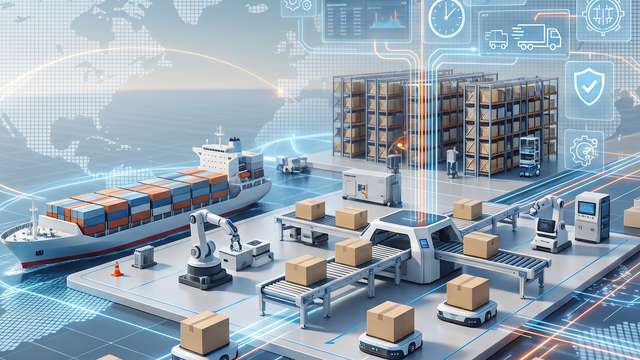
In modern manufacturing, an unscheduled hour of production line downtime can result in losses running into tens of thousands of euros. The operational pressure has never been higher: plants demand uninterrupted continuity, customers expect rapid turnaround, and maintenance departments require critical components delivered immediately. In this environment, the logistics of industrial automation parts is no longer just back-office support - it has become a core competitive advantage.
Table of content
Global supply chains under constant stress
Optimizing the supply chain for industrial automation is a complex, high-stakes operation. The final delivery timeline is dictated by multiple interdependent variables:
- geographically dispersed manufacturing plants and distribution hubs,
- ocean freight capacity constraints and persistent container congestion at key transshipment ports,
- availability of trucking fleets, intermodal links, and air cargo corridors,
- shifting geopolitical factors, evolving customs regulations, and border controls.
Managing the seamless transit of critical components - such as PLC modules, variable frequency drives (VFDs), and servo systems - requires comprehensive end-to-end visibility. Suppliers, carriers, and procurement teams must operate on real-time data, tracking everything from in-transit conditions to digital documentation workflows.
The paper trail bottleneck: Where critical time is lost
International transit is as much about data compliance as it is about physical movement. A single discrepancy in trade, customs, or banking paperwork can halt a shipment at a terminal or clearance point for days.
A resilient transit operation relies on absolute precision across essential trade documentation:
- Consignment notes and bills of lading tailored to each transport mode (CMR for road freight, CIM/SMGS for rail, AWB for air cargo, and Ocean Bills of Lading/BL for maritime freight),
- Commercial invoices and packing lists with precise item specifications,
- Customs declarations, HS classifications, and certificates of origin,
- Safety Data Sheets (MSDS) and regulatory filings for hazardous cargo (ADR/RID/IATA-DGR),
- Electronic Proof of Delivery (e-POD) for immediate verification.
While the widespread adoption of digital customs systems and standardized Incoterms rules has reduced administrative friction, a fundamental rule of physical logistics remains unchanged: the greater the transit distance, the higher the exposure to unexpected disruption.
Resilience over risk: The strategic value of local warehousing
Global supply chain disruptions over recent years have forced manufacturers to rethink legacy strategies. The fragile just-in-time model is increasingly giving way to supply chain resilience and nearshoring. Sourcing replacement parts from a supplier within hundreds of kilometers - rather than thousands - bypasses maritime chokepoints and customs delays altogether.
This operational resilience forms the foundation of Automation Trader.
For years, we have helped stabilize production across critical sectors of European industry, including automotive, electrical manufacturing, metalworking, plastics processing, and medical technology. We specialize in the rapid supply of new, professionally reconditioned (refurbished), and obsolete/legacy automation components from the world’s leading manufacturers.
Instead of waiting for distant production lines to clear or containers to move through congested ports, we dispatch thoroughly tested components directly from our warehouse stock - minimizing downtime and protecting your plant's bottom line.