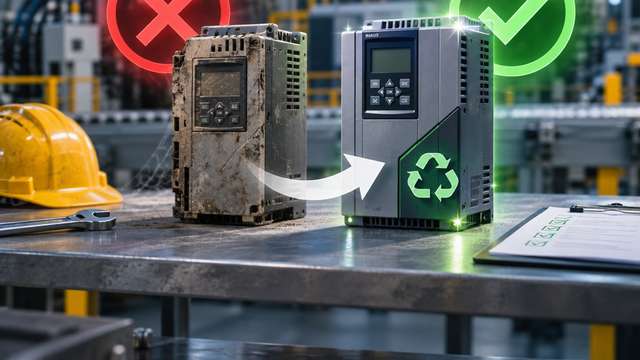

Black Friday. Black Week. Black Weeks. November has become synonymous with massive discounts, flash sales and shopping frenzies. But does the same approach really make sense in industrial manufacturing? Should a maintenance manager purchase a variable frequency drive simply because its price has been reduced by 30%? At Automation Trader, we believe there is a smarter way to approach this season. Instead of launching another discount campaign, we're highlighting opportunities to reduce industrial maintenance costs throughout the year - especially when annual budgets are running low and production cannot afford to stop.
Table of content
- Black Friday on the Factory Floor? It's Not That Simple.
- They buy equipment to keep production running.
- The Budget Is Running Out. The Machines Don't Care.
- New, Used or Refurbished? Three Options Worth Considering.
- The Most Expensive Spare Part?
- December Can Complicate Even a Routine Spare Parts Order.
- Smart Savings Should Never Mean Compromising on Safety
- Black Weeks, the Automation Trader Way
- Don't Wait Until the Budget Runs Out or Production Stops.
Black Friday on the Factory Floor? It's Not That Simple.
Picture the familiar Black Friday experience. A television is 25% cheaper. A coffee machine comes with a 40% discount. A smartphone you've been considering for months is suddenly available at a much more attractive price.
It's easy to understand why millions of consumers look forward to this time of year. Now imagine a completely different environment: a manufacturing facility.
Does anyone really purchase a programmable logic controller (PLC), servo drive or variable frequency drive (VFD) simply because it's on sale? Of course, industrial companies do make planned purchases and build spare parts inventories. However, when it comes to industrial automation, purchasing decisions are usually driven by entirely different priorities.
Technical compatibility. Availability. Reliability. Delivery times. And, above all, the operational requirements of a specific machine or production line. Because industrial companies don't buy equipment just for the sake of buying it.
They buy equipment to keep production running.
That's exactly why Automation Trader is taking a different approach to Black Weeks this year. We're not launching a massive clearance sale. We're not promising spectacular discounts on selected products.
Instead, we're focusing on something that can deliver meaningful financial benefits long after the shopping season is over. We're talking about carefully selected used and refurbished industrial automation components.
The Budget Is Running Out. The Machines Don't Care.
November and December can be particularly challenging months for industrial businesses. Projects need to be completed. Outstanding orders must be fulfilled. Investments have to be accounted for, and next year's budgets and operational plans are already taking shape.
In some facilities, maintenance budgets are almost exhausted. In others, the remaining funds have already been allocated to specific priorities. Unfortunately, equipment failures don't follow financial calendars.
A motor can fail on December 28 just as easily as it can on March 15. A variable frequency drive doesn't check whether the purchasing department has already spent its annual budget. And a malfunctioning PLC won't patiently wait until January for fresh funding to become available.
When critical equipment fails, companies may find themselves facing a difficult decision. On one side is the urgent need to restore production. On the other are limited financial resources, time pressure and potentially unfavorable delivery schedules.
Is purchasing a brand-new component always the only solution? Not necessarily. And that's where a more strategic approach to spare parts procurement begins.
New, Used or Refurbished? Three Options Worth Considering.
For years, many industrial companies have treated brand-new components as the default choice, considering alternatives only when absolutely necessary. But industrial maintenance is rarely that straightforward.
The right component should be selected based on its technical specifications, intended application, condition and availability.
- Brand-new components - remain the preferred option in many situations. They come from manufacturers' production lines or existing inventories, are supplied under defined warranty conditions and have no previous operating history.
- Refurbished components - can offer an attractive alternative. Professional refurbishment involves technical procedures intended to restore the required operating characteristics of a device. Depending on the product, these procedures may include diagnostics, replacement of worn parts and functional testing.
- Used components - also deserve consideration, particularly when the required equipment has been discontinued or a new replacement is difficult to obtain. However, the actual condition of the device, its compatibility with the existing system and the extent of any technical verification are essential factors.
This doesn't mean that all three options are identical. Nor does it mean that the cheapest option will always be the best one. The real advantage is having the freedom to make an informed decision.
After all, why should a manufacturer automatically rule out a component that meets its technical requirements, can be delivered sooner and may cost significantly less?
The Most Expensive Spare Part?
There's a particular paradox in industrial automation. A component worth a few thousand euros can be responsible for keeping a production system worth millions operational. As long as everything works, its importance may go largely unnoticed.
But when that relatively small component fails, an entire production line can come to a standstill.
Consider two hypothetical scenarios.
- In the first, a manufacturing facility urgently needs a specific servo drive. A brand-new replacement can be ordered, but the estimated delivery time is several weeks.
- In the second, a compatible, refurbished unit is available from an established supplier and can potentially be shipped much sooner.
Which option makes more financial sense?
The answer depends on the technical requirements, purchasing conditions and circumstances of the facility. However, when an expensive production shutdown is involved, even a relatively small difference in delivery time can have a major impact.
Because the financial calculation doesn't end with the purchase price. It also needs to account for lost production, delayed customer orders, additional maintenance labor and potential consequences of missed delivery commitments.
Real savings don't always come from buying the cheapest component. Sometimes they come from avoiding the most expensive downtime. That's why availability should be one of the key considerations in industrial spare parts procurement.
December Can Complicate Even a Routine Spare Parts Order.
The end of the year brings another challenge. Many companies prepare for holiday shutdowns, employee leave and changes to operating schedules.
These adjustments affect not only manufacturing facilities but also component manufacturers, distributors and logistics providers. As a result, lead times for certain products may increase.
Of course, this doesn't mean every December shipment will be delayed. Much depends on the manufacturer, warehouse location, stock availability and logistics arrangements. But for a company urgently trying to restart a production line, even a few additional days can have serious consequences.
This is why evaluating alternative sourcing channels in advance makes good business sense. The market for used and refurbished industrial automation equipment can be particularly valuable when dealing with legacy systems, discontinued components or products subject to extended manufacturer lead times.
Instead of relying exclusively on new equipment catalogs, companies can explore multiple sourcing options. And having more options provides greater flexibility when unexpected problems arise.
Smart Savings Should Never Mean Compromising on Safety
One point deserves particular emphasis. Purchasing used or refurbished automation components should never mean abandoning quality requirements.
Quite the opposite. The more critical a component is to a production system, the more carefully its technical condition, compatibility and origin should be assessed.
Before making a purchase, companies should establish whether the device has been tested, what refurbishment procedures have been performed and which warranty conditions apply. Safety-related applications may also require additional technical assessments, approvals or verification procedures.
Not every used component will be suitable for every installation. And not every refurbished product will necessarily be a better choice than a brand-new equivalent.
But that's precisely what informed procurement is about. It's not about choosing the lowest price at any cost. It's about finding the right balance between cost, availability, technical suitability, quality and safety.
Black Weeks, the Automation Trader Way
This year, we've decided to approach Black Weeks a little differently. Instead of running another discount campaign, we're using this period to share knowledge and highlight purchasing opportunities that industrial companies may sometimes overlook.
Our goal is to demonstrate that professionally refurbished and appropriately verified used components can represent valuable alternatives to brand-new industrial automation equipment. Especially when time, availability or a limited budget becomes a critical factor.
At Automation Trader, we help customers source industrial automation components that match their actual operational requirements.
PLCs, variable frequency drives, servo drives, electronic modules and many other components — whether brand-new, refurbished or used - all require careful selection. That's why we encourage companies to compare their available options.
Do you have a specific part number?
Are you looking for a replacement component for an older machine?
Has the manufacturer quoted a delivery time that your production schedule simply cannot accommodate?
It may be worth exploring an alternative.
We don't promise that every component will be immediately available. Nor do we claim that refurbishment is always the most economical solution. What we do believe is that informed comparisons can help industrial companies manage their maintenance budgets more effectively and reduce the risk of costly downtime.
Because in industry, a genuine opportunity doesn't always come with a red “SALE” label. Sometimes, it's simply the right component, available at the right time, at a reasonable price.
Don't Wait Until the Budget Runs Out or Production Stops.
The final weeks of the year are a good opportunity to review your spare parts procurement strategy. Identify the components that are critical to your production. Check the availability of equipment that manufacturers no longer supply.
Compare the possibilities offered by brand-new, used and refurbished components. And if you need help sourcing a specific part, contact Automation Trader.
Send us the part number of the component you're looking for. We'll check the available sourcing options and help you find a solution suited to your facility's needs.
AUTOMATION TRADER - WE DON'T CUT PRICES. WE SHOW YOU HOW TO CUT COSTS.