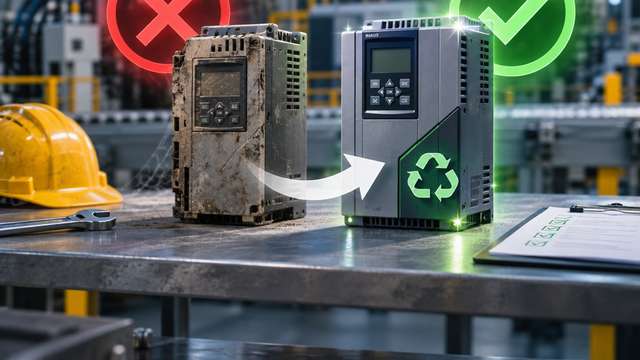
Brand-new or refurbished? For many industrial businesses, the choice still seems obvious. But what happens when a production line suddenly stops, the manufacturer quotes a lead time of several weeks, and every hour of downtime adds to the financial damage? In these circumstances, insisting on brand-new components may prove to be an expensive decision. Yet refurbished industrial automation parts remain surrounded by misconceptions. It is time to separate the myths from the facts.
Table of content
- MYTH 1: Refurbishment Is Nothing More Than Cleaning an Old Component
- MYTH 2: Refurbished Components Are Less Reliable Than Brand-New Equipment
- MYTH 3: Refurbished and Used Parts Are Exactly the Same Thing
- MYTH 4: Refurbished Industrial Parts Do Not Deliver Meaningful Savings
- MYTH 5: Refurbished Equipment Is Too Risky for Industrial Production
- MYTH 6: Refurbished Parts Are Harder to Find Than New Ones
- December Downtime Can Be Expensive. Is Your Facility Prepared?
Picture a situation that maintenance managers know all too well.
It is mid-December. A manufacturing facility is racing to fulfil its final orders of the year. Production schedules are stretched to their limits, deadlines are approaching, and there is little room for unexpected disruption.
Then, without warning, a critical variable frequency drive fails.
The maintenance team contacts the original equipment manufacturer, hoping for a quick replacement. Unfortunately, the answer is far from reassuring. A brand-new unit can be ordered, but delivery will not be possible until January.
The alternative? A potentially expensive system upgrade requiring additional engineering work, budget approval and time the company simply does not have.
Situations like this expose a fundamental weakness in industrial spare parts procurement: relying exclusively on new equipment.
Refurbished programmable logic controllers (PLCs), variable frequency drives (VFDs), servo drives and electronic modules can provide a practical alternative. Depending on the specific product, they may offer substantial cost savings, shorter lead times and continued support for equipment that manufacturers no longer produce.
So why do some industrial companies remain reluctant to consider them?
MYTH 1: Refurbishment Is Nothing More Than Cleaning an Old Component
One of the most persistent misconceptions about refurbished industrial equipment is that the process involves little more than cleaning a used component, improving its appearance and putting it back on the market.
Professional refurbishment, however, is considerably more involved.
Its purpose is to restore equipment to defined operational standards through a structured technical process.
Depending on the type and condition of the component, this may involve detailed diagnostics, inspection of electronic assemblies, replacement of worn or deteriorated parts, restoration of individual systems and functional testing.
For sophisticated industrial electronics, identifying potential weaknesses before a component returns to service can be particularly important.
Nevertheless, refurbishment is not a universally standardised procedure. The scope of work depends on the equipment, its condition and the technical standards applied by the refurbishment provider.
This distinction matters.
Rather than asking whether a refurbished component looks brand-new, industrial buyers should ask a much more relevant question: what exactly has been inspected, restored, replaced and tested?
VERDICT: MYTH BUSTED.
MYTH 2: Refurbished Components Are Less Reliable Than Brand-New Equipment
There is a certain reassurance that comes with purchasing new equipment.
It arrives directly from the manufacturer or an authorised distribution channel, has no previous operating history and is typically covered by the manufacturer's warranty.
But does this automatically mean that a professionally refurbished component cannot deliver the reliability required for industrial applications?
Not necessarily.
A properly executed refurbishment process, supported by appropriate testing, can restore a component's ability to meet the operational requirements of its intended application.
The critical factors are the quality of the refurbishment work, the condition of the equipment, the parts used during restoration and the effectiveness of the final testing procedures.
However, it would be misleading to suggest that every refurbished component is automatically equivalent to a factory-new product in every respect. Such claims must be supported by the specific technical procedures and verification results involved.
This is precisely why supplier selection is so important.
At Automation Trader, the focus is on helping industrial customers source components that meet their technical requirements, with clear information about product condition and applicable warranty terms.
Ultimately, industrial reliability is not determined by a label stating "new" or "refurbished".
It depends on whether the equipment can perform its intended function consistently and safely.
VERDICT: MYTH BUSTED - PROVIDED REFURBISHMENT IS CARRIED OUT TO APPROPRIATE STANDARDS.
MYTH 3: Refurbished and Used Parts Are Exactly the Same Thing
This misconception contains an element of truth, but it overlooks several important distinctions.
Many components entering the refurbishment market have previously been installed in industrial machinery.
They may originate from decommissioned production lines, equipment upgrades, factory closures or systems that have been replaced despite remaining operational.
However, previously operated equipment is not the only source.
The market also includes surplus inventory, returned products and components that have remained in storage for extended periods.
Some of these products may require inspection, testing or replacement of age-sensitive elements even if they have never been used in production.
It is therefore essential to distinguish between three categories: used, repaired and refurbished equipment.
A used component may be offered for resale without undergoing any technical restoration.
A repaired component has generally undergone work intended to correct a particular fault.
Refurbishment, by contrast, may involve a broader process designed to restore the equipment to defined operational requirements.
These categories should not be treated as interchangeable.
For industrial buyers, the most relevant considerations are the component's actual technical condition, the work performed and the evidence supporting its suitability for further operation.
VERDICT: PARTIALLY TRUE.
MYTH 4: Refurbished Industrial Parts Do Not Deliver Meaningful Savings
When it comes to industrial procurement, financial considerations are impossible to ignore.
Depending on the manufacturer, product model and market conditions, refurbished automation components can be significantly less expensive than their brand-new equivalents.
In selected cases, the difference may reach as much as 70%.
However, this figure should not be interpreted as a universal discount across the refurbishment market.
More importantly, focusing exclusively on the purchase price can obscure the much greater financial implications of equipment downtime.
Consider two scenarios.
In the first, a manufacturer orders a brand-new servo drive but must wait several weeks for delivery.
In the second, the company sources a compatible, professionally tested refurbished unit that is available considerably sooner.
The potential benefit of the second option extends well beyond the difference in purchase price.
Unplanned downtime can generate substantial indirect costs, including lost production, delayed customer orders, additional maintenance work and contractual penalties.
For this reason, spare parts procurement should increasingly be evaluated in terms of the **total cost of restoring production**, rather than simply the price of an individual component.
A lower purchase price is valuable. Avoiding an extended production shutdown can be considerably more valuable.
VERDICT: MYTH BUSTED.
MYTH 5: Refurbished Equipment Is Too Risky for Industrial Production
Every industrial equipment purchase involves a degree of risk.
This applies to new components as well as refurbished alternatives.
With refurbished equipment, however, supplier transparency and technical verification become especially important.
Has the component been properly tested? Does it meet the technical requirements of the installation? Is it compatible with the existing control system? What warranty protection is available? What happens if the equipment develops a fault?
These are questions that should be addressed before a purchasing decision is made.
Working with an experienced industrial automation supplier such as Automation Trader enables customers to evaluate available options and identify solutions suited to their operational requirements.
Of course, refurbished equipment is not necessarily appropriate for every application.
Safety-critical systems, specialised machinery and installations subject to strict certification requirements may demand additional verification or specific manufacturer-approved solutions.
The objective should never be to select refurbished equipment regardless of the circumstances.
Instead, companies should make informed procurement decisions based on technical suitability, documented quality and operational risk.
Rejecting refurbishment automatically is not effective risk management. Neither is purchasing refurbished equipment without adequate verification.
VERDICT: PARTIALLY BUSTED - THE LEVEL OF RISK DEPENDS ON QUALITY, VERIFICATION AND APPLICATION.
MYTH 6: Refurbished Parts Are Harder to Find Than New Ones
For widely available components that remain in active production, purchasing a new unit may be the simplest option.
The situation changes dramatically when older industrial machinery is involved.
Across manufacturing facilities, many production systems continue operating effectively long after their original components have been discontinued.
These machines may still meet production requirements, making a complete system replacement difficult to justify financially.
The challenge begins when a critical electronic component fails.
If the original manufacturer has discontinued the product, sourcing an identical new replacement may be impossible.
Installing a modern alternative can also require changes to the control system, software, wiring or other elements of the installation.
This is where the refurbished equipment market becomes particularly valuable.
It can provide access to legacy PLC modules, servo drives, frequency converters and other industrial components that are no longer available through conventional distribution channels.
Availability is never guaranteed, of course.
It depends on existing inventory, the specific product reference and the supplier's ability to source suitable equipment.
Nevertheless, excluding refurbished components from the procurement process can unnecessarily restrict the options available to maintenance teams.
VERDICT: PARTIALLY BUSTED - AVAILABILITY DEPENDS ON THE COMPONENT AND MARKET CONDITIONS.
December Downtime Can Be Expensive. Is Your Facility Prepared?
The final weeks of the year can be particularly challenging for industrial maintenance and procurement teams.
Many manufacturers are working to complete outstanding orders while simultaneously preparing for holiday shutdowns, scheduled maintenance and the start of a new financial year.
At the same time, suppliers may operate with reduced staffing levels, logistics schedules can change, and some manufacturers temporarily suspend or limit order processing.
Under these circumstances, the failure of a relatively small automation component can quickly become a major operational problem.
The most effective response is preparation.
Industrial businesses should identify critical spare parts, assess the availability of replacements and review their dependence on individual suppliers or product lines before an emergency occurs.
This does not mean abandoning brand-new equipment.
It means recognising that new components are not always the only technically appropriate or commercially sensible option.
Refurbished variable frequency drives, PLCs, servo drives and other industrial automation components can form an important part of a resilient spare parts strategy.
This is especially true when the alternatives involve extended lead times, costly engineering modifications or premature replacement of machinery that could otherwise remain in productive service.
At Automation Trader, we support industrial businesses in sourcing automation components that match their technical and operational needs, including both new and refurbished equipment.
Our objective is to help customers evaluate available solutions with a clear understanding of cost, compatibility and availability.
Because in modern manufacturing, success does not always belong to the company investing in the newest equipment.
Sometimes, it belongs to the company that can restore production faster, control costs more effectively and make better use of the machinery it already owns.
Do not wait for a year-end breakdown to expose a gap in your spare parts strategy. Check the availability of critical automation components before downtime becomes an emergency.