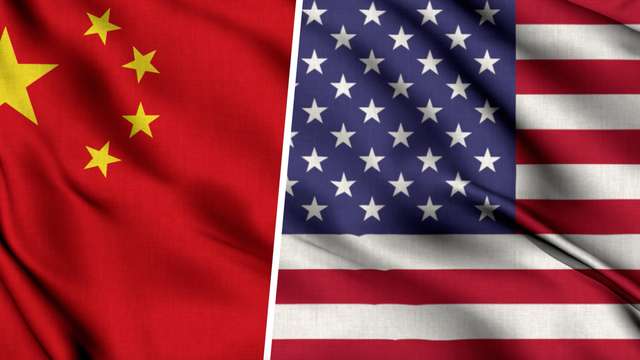
Another trade war between China and the US? Not a chance of that! According to an exhaustive analysis by The Diplomat, the coming months will be quiet in this regard, but there is much more concern about the year ahead.
Table of contents
Recently, there has been what can safely be called a ‘normalisation’ of relations between Beijing and Washington. After a very turbulent period, the superpowers have set their sights on lowering the temperature of mutual friction, which has been quite evident precisely in trade relations. However, all good things come to an end, and analysts who deal with this issue on a daily basis have no doubt that the prognosis for the future is uncertain and difficult to clearly predict.
The giants have taken care of themselves
Why all this ‘normalisation’ of mutual relations - at least on a commercial level? For a very simple reason. Both giants are much more preoccupied with their internal affairs today. In the USA, there has been a lot of talk until recently about the Texas rebellion and the spectre of a possible civil war, and, as if that were not enough, there has been an election campaign across the Atlantic for months, in which not only political parties, but actually two different philosophies and visions of how the country should function are clashing.
As far as the Chinese are concerned, here the party has bet - and quite strongly - on internal development. This is because, beyond the Great Wall, they have recognised that investment in the economy, industry and the development of new technologies is now the subject to which much more attention should be devoted.
The spectre of conflict
This temporary cooling of the temperature of mutual tensions, which has escalated strongly since Nancy Pelosi's famous visit to Taiwan, will not last forever, however. For the situation in the Pacific continues to be a bone of contention in relations between the major players on the international stage.
However, that is not all. Disputes in the geopolitical arena are only one side of the coin. The other is the aforementioned technological development. Not since yesterday have we known that the US has been severely restricting China's access to new technologies. The Huwaei case, on the other hand, is just the tip of the iceberg and something that Beijing is particularly uncomfortable with. Hence, among other things, the decision to step up efforts on this front so that the technological gap between China and the US narrows in the long term.
Washington, on the other hand, also feels the writing with its nose. The White House is well aware that unimaginable resources have been mobilised in China to ‘catch up with the West’. So it should come as no surprise that restrictions on technology transfers and, in particular, artificial intelligence solutions, can only go forward.
The elections will tell the truth
A legitimate question from the point of view of this relationship, on the other hand, is who will sit behind the desk in the Oval Office in the autumn? And there is no fooling ourselves, this will be one of the main factors that will affect China's relationship with the US in the near future.
A possible change of Cabinet could bring a number of changes in this aspect. It all depends on what the new president will bet on or how much the current ruling camp will modify its policies. However, one would be mistaken who thinks that in either case there could be some kind of spectacular breakthrough.
Two further aspects - in the opinion of The Diplomat's analysts - are of course the economic condition of both countries, including the magnitude of inflation, social inequalities, economic slowdowns or, finally, demographic problems.
Finally, of course, there is the military tension and the ever-increasing military presence of the United States. The entire region of Taiwan and the Pacific now resembles a powder keg, where a single spark could lead to an explosion on a huge scale. The Americans have no intention of letting up, while the Chinese may perceive even a trivial training action as a provocation.
Or is it dialogue after all?
Despite these uncertainties, there are also some positive signs. Both sides are continuing dialogue and cooperation in selected areas, such as climate change and public health. Working together in these areas could help to ease tensions and provide a platform for more constructive common ground in the future.