
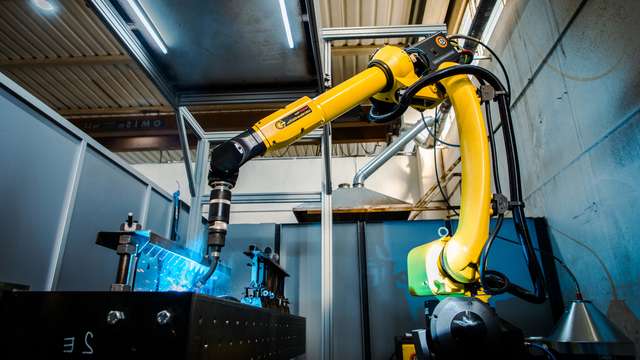
In recent months, Japanese automation giant FANUC has clearly accelerated the pace of innovation in industrial robotics and control systems. While there hasn’t been one headline-grabbing "breakthrough" the past half year has brought important developments that matter directly to production engineers and maintenance teams.
Table of content
- Robots for Special Applications - Machining and Harsh Environments
- Smarter Controllers and Integration Tools
- Robots for Clean and Regulated Environments
- New-Generation SCARA and Simulation Software
- Portfolio Stability - No Model Discontinuations
- Support and Reliability in Practice
- What It Means for Maintenance and Production Teams
New robot models, expanded controller functionality, and modular automation solutions all point to one thing: FANUC is preparing for the next decade of industrial automation in increasingly demanding production environments.
Robots for Special Applications - Machining and Harsh Environments
One of the most interesting trends is FANUC’s move into robotic machining - robots capable of operating in environments traditionally reserved for CNC machines.
The new M-810/270F-27B, unveiled at FABTECH 2025, is designed for aluminum milling and drilling applications that use coolant. The robot’s reinforced structure and sealed joints make it suitable for wet machining, where precision and resistance to corrosion are critical.
In practice, this could allow robots to take over flexible machining or pre-finishing operations, reducing the need for dedicated CNC setups in small-batch or retooling-heavy production cells.
Precision Path Control - M-800iB / 60-20B
Another recent model, the M-800iB / 60-20B, is optimized for operations requiring high path accuracy, such as laser cutting or finishing processes.
This robot can integrate with laser interface units and maintain exceptional trajectory precision - a key challenge in robotic motion control. For maintenance teams, this means fewer specialized machines to service and greater flexibility in repurposing robots for high-accuracy tasks.
Heavy-Duty Performance - M-1000/550F-46A
At EMO 2025, FANUC also announced the M-1000/550F-46A, a long-reach, high-payload robot built around the new R-50A controller, which delivers improved processing power and motion accuracy.
Designed for handling large or heavy components - such as die-cast parts, molds, and automotive chassis modules - this robot expands the scope of automation into areas that previously required cranes or manual lifting systems.
Smarter Controllers and Integration Tools
Equally important as the robots themselves are the new controller capabilities. The latest R-50iA can now function as a full software PLC, allowing engineers to integrate robot control and peripheral device management within one system.
The Remote Operation Robot function adds remote control and diagnostics, while new RTU (Robot Transfer Unit) modules enable robots to travel along extended tracks for multi-station operation.
These features make it easier - and often cheaper - to adapt existing production lines without major redesigns.
Robots for Clean and Regulated Environments
FANUC has also expanded its range of Food-Grade and Cleanroom robots, aimed at industries such as food processing, pharmaceuticals, and electronics assembly.
These robots feature sealed housings and smooth, easy-to-clean surfaces, making them suitable for sterile or contamination-sensitive production zones - a clear response to stricter hygiene and traceability standards worldwide.
New-Generation SCARA and Simulation Software
In parallel, FANUC introduced updated SCARA robots (SR-9 and A/R series), combining increased payload capacity with faster cycle times and higher positioning accuracy.
Alongside hardware upgrades, FANUC released ROBOGUIDE V10, a new version of its offline simulation software, offering better motion fidelity and support for digital twin integration - valuable for design and commissioning engineers.
Portfolio Stability - No Model Discontinuations
Notably, FANUC has not announced any model discontinuations in the past half year. All current robot and controller families remain fully supported.
For industrial users, this continuity means long-term serviceability and confidence in future retrofits or expansions - a key consideration in environments where uptime and spare-part availability are crucial.
Support and Reliability in Practice
New robots and smarter controllers are only part of the story. What truly determines reliability on the shop floor is access to parts, knowledge, and timely support.
That’s why experienced suppliers play a growing role in maintaining production stability.
Among them, Automation Trader has built a reputation as a trusted partner in the field of industrial automation. The company provides original FANUC components and supports systems of multiple generations - helping maintenance teams find the right parts, plan upgrades, and minimize costly downtime.
Working with a partner who understands both legacy and modern automation platforms translates into one clear advantage: dependable performance when production can’t afford to stop.

What It Means for Maintenance and Production Teams
From a practical standpoint, FANUC’s latest developments bring several tangible benefits:
- Higher durability in harsh conditions (coolant, moisture, dust)
- Simpler integration via controller-level PLC functions and remote tools,
- Greater flexibility through modular RTU units and heavy-duty robots,
- Easier access to replacement parts and technical expertise through partners such as Automation Trader,
- Assured long-term support for existing installations.
FANUC’s focus over the past half year hasn’t been on flashy announcements, but on meaningful progress - practical improvements that matter to real production floors.
From precise SCARAs to coolant-resistant machining robots and long-reach heavy handlers, FANUC’s current direction confirms one thing: industrial automation is becoming more adaptable, more reliable, and better aligned with the everyday realities of modern manufacturing.