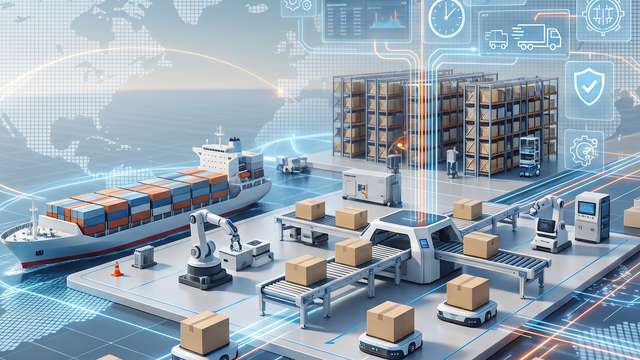
Industrial automation is evolving at remarkable speed. In 2025, many of the concepts once considered experimental are now becoming part of everyday operations on the factory floor. Production systems are gaining the ability to adapt on the fly, data is flowing more freely than ever before, and companies are rethinking how to design processes for flexibility rather than rigidity. Below is a look at the dominant trends shaping today’s industry and the developments likely to define the year ahead.
Spis treści
1. AI as a co-operator: From data insight to real-time decision-making
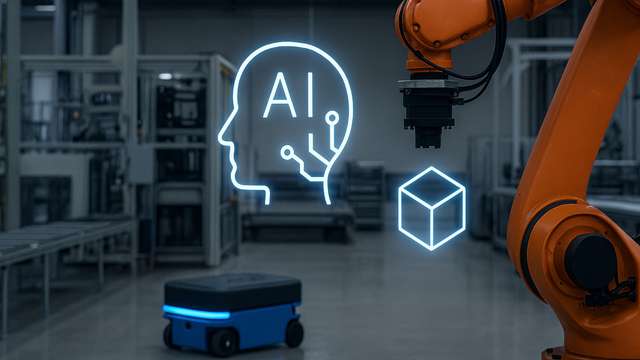
Artificial intelligence has moved beyond dashboards and reports. In 2025, AI systems increasingly operate side-by-side with human teams, interpreting machine signals, detecting anomalies, and recommending the best operational response.
In logistics centers, AI analyzes conveyor loads and automatically optimizes line speed. Automotive plants are reporting double-digit reductions in unexpected downtime thanks to predictive maintenance algorithms that identify early signs of component fatigue. Crucially, modern AI models are becoming context-aware: they distinguish between a temperature spike caused by heavy workload and one that signals mechanical wear.
Outlook for 2026: AI will start making more autonomous adjustments in low-risk areas, and more models will be trained directly on production lines, dramatically shortening implementation time.
2. Flexible manufacturing driven by modular robotics and autonomous transport
One of the most transformational shifts in 2025 is the rise of modular robotic systems and autonomous AGV/AMR fleets. Companies are moving away from fixed, "cemented-in-place" production layouts and embracing factories that can be reconfigured in hours, not weeks.
Food manufacturers use modular pick-and-pack robots to switch packaging formats on the fly. Electronics producers reassign cobots between workstations based on changing workloads, while autonomous mobile robots dynamically recalculate their routes in response to shifting material flows.
Outlook for 2026: Modular automation will become a baseline expectation. Machine builders are already developing plug-and-play robotic "building blocks" - fully integrated work modules that can be combined, rearranged, and seamlessly connected to MES or SCADA platforms.
3. Digital twins: From design tool to operational companion
Digital twins are no longer exclusive to global corporations. In 2025, mid-sized manufacturers increasingly rely on virtual models to simulate process changes without interrupting production. They are used to optimize material flow, test machine behavior under various conditions, and predict how parameter adjustments affect product quality.
A Polish furniture producer recently used a digital twin to redesign its plant layout, reducing internal transport distances by over 20 percent. In the chemical industry, real-time reactor simulations help operators fine-tune temperature and pressure for maximum throughput.
Outlook for 2026: Digital twins will evolve into operational decision engines. Instead of merely simulating scenarios, they will provide live recommendations to operators - and, in some cases, directly adjust machine settings after validating scenarios in the virtual model.
4. Operational cybersecurity: A priority that can no longer be ignored
As factories become more connected, the number of cybersecurity incidents targeting OT environments is rising. In 2025, production plants are increasingly confronted with ransomware attacks and attempts to manipulate PLC logic. The weakest points often remain unchanged: poorly segmented networks and outdated controller firmware.
In response, companies are strengthening their defenses. Manufacturing organizations now deploy network monitoring tools traditionally used in IT and train staff to recognize unusual machine behavior. The pharmaceutical industry is leading the way with mandatory cybersecurity audits for every new machine before it enters the plant network.
Outlook for 2026: OT cybersecurity will become an integral component of every automation investment. Vendors will face growing requirements for documented security testing, and industrial IDS/IPS solutions will become as standard as backup power systems.

The developments unfolding in 2025 confirm that industrial automation is entering a new era - one defined by intelligence, flexibility, and secure digital operations. As manufacturers look toward 2026, the winners will be those who invest in scalable, modular, and cyber-resilient technologies. They will be best positioned to capitalize on the next wave of autonomous factory capabilities and data - driven performance improvements.