The automation sector has had several breakthrough moments throughout its history. One of them was undoubtedly the appearance of PLC controllers on the market.
Table of Contents
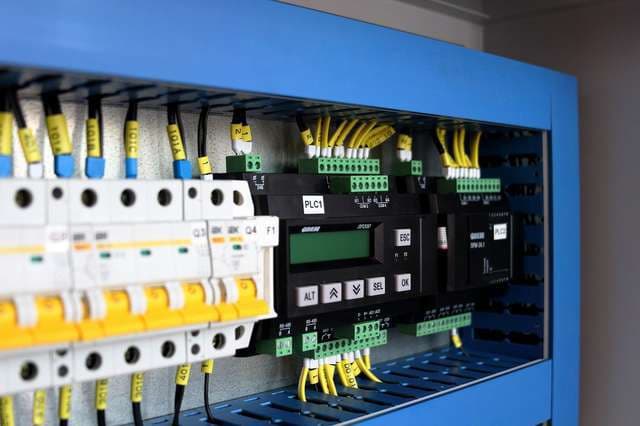
Programmable logic controllers, as this is the full name of the device, are actually small industrial computers that are used to control a whole range of machines. Pumps, motors, fans or switches - wherever they are, we can also find the mentioned PLC.
What are PLCs?
- Naming these devices as PLC drivers does not make a bit of sense, because just like in the case of LEDs, also here the abbreviation contains the name itself - programmable logic controller - admitted Automation Trader expert Mariusz Lenar, who you can hear in the Creators Workshop series.
Before the first logic controllers saw the light of day in 1968, the processes related to industrial automation were performed with the help of relay circuits. This, however, meant that even the simplest activity caused problems, and as you know, these are there to be solved. And so it happened, and although the first PLCs had quite limited capacity, over time, their importance and capabilities increased.
Today they are just small computers with enormous power. - Such a controller can of course be programmed in various ways and assigned various functions, so that it collects information, then transforms it appropriately according to the program, and finally sends the output to the device of interest to us - added Lenar.
- What exactly is such a driver? It's basically a computer, at least in theory, the kind we have at home. Of course, there are no graphics cards or hard drives, but the principle of operation is identical. His job is to gather information, transform and send, he continued.
Simpler and more stable
So one might ask why ordinary computers are not used to control machines? - Because too much complexity of operating systems and too many built-in devices could cause the system to freeze and stop such a machine, and nobody would want to let that happen - he added.
PLC controllers are simpler and much more stable in this respect. What's more, they have outputs that are able to handle much greater loads than ordinary computers. Of course, you can also connect other modules to them, but the multitude of them increases the risk of communication and error. When it comes to PLC, we get everything in one device.
Today, the logic controller market is extremely spacious and offers customers an extraordinary choice. Among the most popular manufacturers, you can find, among others Siemens, Fanuc, Mitsubishi, ABB, Allen-Bradley equipment or slightly smaller Wago controllers.
 Play video
The luxury of choice is therefore enormous, but it is worth going back a bit in time for a moment and remembering what it looked like before the invention of microcontrollers - before the era of transistors. - In the old days, machines were controlled by small relays. How is this possible when it only has a contact that can only be closed or open and basically has no memory? Yes, it is true, but in combination with many relays it can already perform complex functions - added Mariusz Lenar. - PLCs work on the same principle, but nowadays transistors are used instead of relays - he concluded.
If you are interested in PLC devices that you have not found in the Automation Trader offer, please contact us - we will try to solve your problem.