
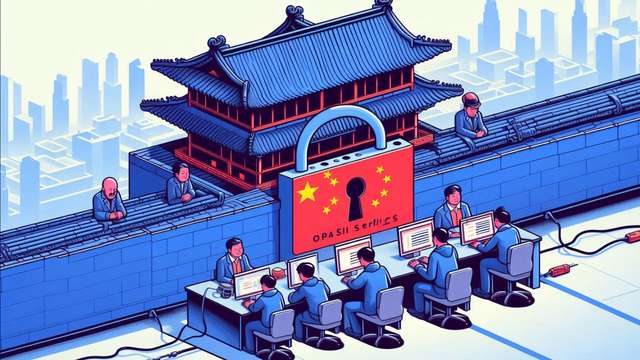
The technological clash between the US and China continues at its best. Its latest development is OpenAI's decision to block access to its services for specialists from beyond the Great Wall.
Table of contents
This decision has caused quite a stir among Chinese developers, who from now on must look for alternative ways to use advanced AI models. The blocking of access to OpenAI's APIs in China and Hong Kong has forced many professionals to wring out all their creativity in order to still be able to use popular - and sometimes essential - tools such as ChatGPT.
Illegal but effective
The blocking of OpenAI does not mean the end for Chinese developers, however. Many of them immediately started using VPNs and third-party services that still offer access to GPT.
Although OpenAI had previously tried to prevent such workarounds, developers found ways to hide their activities, such as using accounts registered to foreign phone numbers. Although the use of unapproved VPNs is illegal in China, the need to access advanced AI tools has proved stronger, even if it involves breaking the law in a country where you can pay very dearly for doing just that.
Where to look for alternatives?
OpenAI's blocking of access has also forced many Chinese developers to consider local alternatives, which, by all accounts, may turn out to be something extremely stimulating for local technology development.
More and more competing models are emerging in the Chinese AI market, trying to match their foreign counterparts. And already there are voices saying that if the aforementioned lockout of OpenAI continues for a longer period of time, developers will be inclined to switch completely to indigenous platforms that are working hard to achieve high technological standards, reports the South China Morning Post.’
This is a rather interesting aspect, as by blocking the Chinese in the short term, OpenAI may in the long term lead to them working behind the Great Wall more effectively and faster than anyone assumed to develop and adapt their unique solutions.
Technological clash
It is, of course, worth remembering at this point that the decisions of OpenAI and other tech giants such as Google and Anthropic to block access for Chinese users are part of a wider geopolitical game.
US sanctions and US-China tensions are affecting the availability of advanced technologies in the region. Microsoft, a major OpenAI partner, continues to maintain access to its services in China, which can be a key competitive advantage in this rapidly changing environment.
The OpenAI decision today is one of many challenges facing Chinese developers. However, their flexibility and willingness to adapt show that the Chinese AI market is ready for rapid change and new technological challenges.
For our part, it remains to follow this geopolitical and technological showdown between giants and eagerly await its next act.