
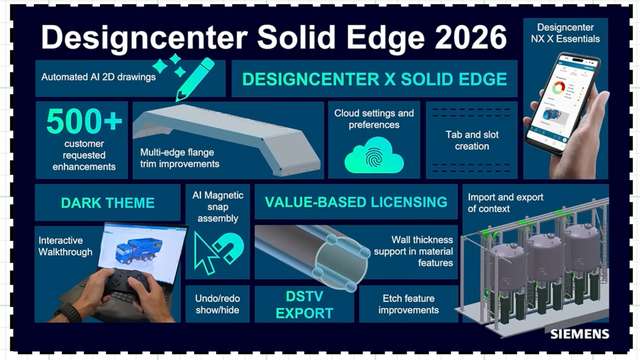
On October 22, 2025, Siemens Digital Industries Software introduced the latest release of its design and engineering environment - Designcenter Solid Edge 2026. At first glance, it might seem like just another CAD update. But for industrial automation professionals, this launch carries a deeper message: Siemens is tightening the integration between mechanical design, digital twins, and the automation layer that drives smart factories.
Table of content
Key Innovations
1. Artificial Intelligence at the Core of Design
The 2026 edition introduces several AI-driven capabilities:
- Magnetic Snap Assembly automatically detects connection points between components, suggesting constraints and relations in real time.
- Automated 2D Drawings - up to 80 percent of dimensions and projections can now be generated automatically, reducing tedious manual drafting.
- A built-in Design Copilot - a conversational assistant inside Solid Edge - answers design questions, recommends commands, and speeds up workflows.
2. Sheet-Metal and Assembly Enhancements
New commands like Tab and Slot simplify fabrication of sheet-metal parts, adding precision to weld-ready joints. Improved wall-thickness controls support lighter constructions, while 3D PDF export and richer PMI annotations help align design with manufacturing and maintenance documentation.
3. Cloud Integration and Flexible Licensing
Siemens also introduced Designcenter X Solid Edge, a cloud-based SaaS edition with cross-device synchronization. Engineers can log in from any workstation and continue seamlessly. Token-based licensing lets companies activate high-end modules - like simulation or generative design - only when needed, making advanced design tools more accessible to smaller automation suppliers.
Why It Matters to Industrial Automation
While Solid Edge is rooted in the CAD world, the implications for automation are significant:
Faster transition from mechanical design to commissioning
AI-driven automation of assemblies and documentation accelerates early engineering phases. This shortens the time before control systems, PLCs, or robots can be integrated - a critical advantage in high-mix, short-lead-time production.
A stronger foundation for the Digital Twin
Every improvement in model fidelity and documentation directly benefits automation engineers who simulate control logic, robot paths, or sensor layouts. A better digital model means smoother integration with Siemens’ Process Simulate, NX Mechatronics Concept Designer, and virtual PLC environments.
Fewer design-related integration errors
Automated dimensioning and smarter geometry validation reduce typical problems faced during installation - mismatched panels, inaccessible control cabinets, or mounting misalignments. The result: fewer surprises during commissioning.
Bridging mechanical, electrical, and control design
Cloud-based collaboration helps mechanical and automation teams work on synchronized models. This closes the gap between mechanical assemblies and electrical or control schematics - a step toward true multidisciplinary engineering.
Lower entry barriers
Token-based, pay-as-you-go licensing could democratize access to advanced Siemens software, allowing smaller system integrators and OEMs to leverage professional design tools without heavy upfront investment.

Strategic Context
Designcenter Solid Edge 2026 reflects Siemens’ broader strategy of "software-defined automation". As the company continues to merge design, simulation, and control into one ecosystem, each new release builds a bridge between the digital twin and the shop floor. The introduction of embedded AI and flexible deployment is not just a product update - it’s a signal that automation itself is becoming increasingly automated.
For automation engineers, machine builders, and integrators, the takeaway is clear: design and control are converging. Those who embrace digital-twin workflows and AI-assisted engineering will shorten project cycles, reduce commissioning risk, and gain a competitive edge in the era of intelligent manufacturing.