In the fast-paced world of professional catering, where efficiency and timing often determine profitability, a new technological breakthrough is emerging - automated dishwashing powered by robotics and artificial intelligence. German manufacturer MEIKO Group has announced a partnership with Fizyr and Yaskawa Europe to develop a fully automated dishwashing solution for professional kitchens. The prototype was unveiled at Automatica 2025 in Munich, marking a significant step toward a future where dishwashing may no longer require human hands.
Table of content
Below is an in-depth look at the project, the technologies behind it, and what it could mean for the global hospitality industry.
The Partnership: Three Specialists, One Vision
MEIKO - The Cleaning Expert
Founded in 1927, MEIKO is one of the global leaders in professional cleaning and disinfection technology, supplying solutions for restaurants, hospitals, and large catering facilities. With nearly a century of expertise, MEIKO contributes its process engineering knowledge, experience in kitchen integration, and deep understanding of hygiene and workflow requirements.
Fizyr - The Machine Vision Brain
Fizyr, a Dutch company specializing in vision AI, provides the system’s “eyes.” Their software enables robots to recognize and manipulate objects of varying shapes, sizes, and cleanliness. Using deep learning, Fizyr’s algorithms analyze camera feeds to identify dishes, calculate optimal grasp points, and relay instructions to the robotic arm for precise handling.
Yaskawa Europe - The Motion Expert
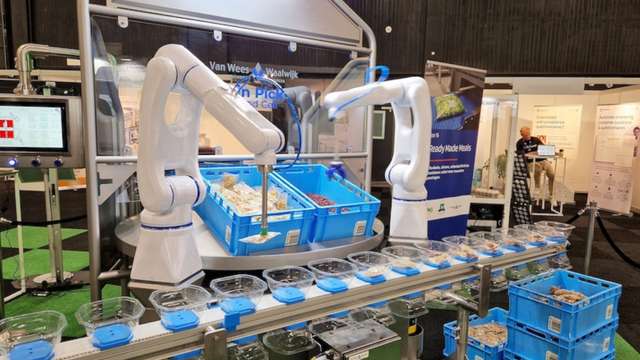
Yaskawa, a renowned name in industrial automation, contributes its advanced Motoman robotic arms and drive systems. These ensure smooth, precise, and coordinated motion during the dish-handling process. The prototype, showcased at Automatica 2025, demonstrated how Yaskawa’s robotic arm - guided by Fizyr’s AI - can autonomously sort, pick, and place dishes into the MEIKO cleaning system.
Together, these three companies bring complementary expertise: cleaning technology (MEIKO), computer vision (Fizyr), and robotic motion (Yaskawa) - forming a robust alliance that bridges mechanical, digital, and process innovation.
How It Works: Inside the Demonstrator
During the demonstration at Automatica 2025, the system performed a full dish-handling cycle under realistic working conditions typical of large-scale kitchens:
-
Dish Recognition - Cameras scan the pile of dirty dishes. Fizyr’s AI identifies each item’s type, shape, and orientation.
-
Grasp Planning - The system determines how to pick up each item - where to grip, how tightly, and at what angle.
-
Pick and Transfer - Yaskawa’s robotic arm picks up the dish and moves it toward the washing unit.
-
Food Residue Removal - A suction module removes larger food remains, reducing the need for manual pre-cleaning.
-
Loading the Dishwasher - The robot precisely places each item inside the MEIKO machine for washing and disinfection.
Observers at the trade fair noted that the system handled a range of dish types - from plates and bowls to cutlery and trays - showing flexibility far beyond early industrial prototypes.
The Technological Challenges Ahead
1. High Object Variability
In professional kitchens, no two dish loads are identical. The system must recognize and handle plates, cups, bowls, utensils, and irregularly shaped containers - often stacked chaotically. Each new item presents a potential edge case, requiring adaptable recognition and motion control.
2. Dealing with Food Waste
Residual food - sauces, bones, vegetable peels - complicates visual detection and gripping. The suction module’s performance in removing these remains will be critical to the system’s overall reliability.
3. Precision and Coordination
A robot strong enough to lift heavy trays must also be gentle enough not to break fragile glassware. Coordination between the AI vision system, motion controller, and manipulator must be exact to avoid collisions or mishandling.
4. Harsh Environmental Conditions
Kitchens are humid, hot, and filled with steam and grease - a tough setting for electronics and sensors. All system components must withstand these conditions and remain easy to clean and maintain.
5. Integration with Existing Kitchen Infrastructure
To succeed commercially, the system must seamlessly connect with existing dishwashing lines, conveyors, and kitchen layouts without major redesigns.
6. Cost and ROI
While promising, such systems must prove economically viable compared to labor costs and operational efficiency. Smaller kitchens may initially find the investment prohibitive.
Future Applications and Industry Impact
Large-Scale Catering and Hospitality
The first adopters will likely be large facilities - hotels, hospitals, airlines, and catering centers - where thousands of dishes need cleaning daily. Here, automation could drastically reduce labor demand and improve hygiene consistency.
Addressing Labor Shortages
With hospitality facing persistent staffing challenges, robotic dishwashing could fill repetitive, labor-intensive roles, freeing human staff for tasks requiring creativity and supervision.
Enhanced Hygiene and Process Control
Unlike human workers, robots do not tire or overlook steps. Automated systems can ensure consistent hygiene, optimize loading patterns, and reduce the risk of cross-contamination.
Integration into Smart Kitchens
In the long term, this technology could become part of a broader networked kitchen ecosystem - integrated with IoT systems, predictive maintenance, and workflow optimization tools.
Risks and Considerations
-
Adaptability to new dish types - how flexible the system will be in recognizing non-standard items.
-
Maintenance costs - sensors and robotic joints require regular calibration.
-
User acceptance - kitchen staff must adapt to working alongside automated systems.
-
Compliance - hygiene and food-safety regulations impose strict requirements on such equipment.
-
Market competition - rival automation companies may offer alternative, possibly more affordable, solutions.
Conclusion: The Dawn of the Automated Kitchen
The MEIKO-Fizyr-Yaskawa collaboration is more than a technological curiosity - it represents a tangible step toward the robotic transformation of commercial kitchens. Until now, automation in gastronomy focused mainly on cooking and packaging. Now, the spotlight turns to the “back end” - dish handling, one of the most labor-intensive and least appealing kitchen tasks.
If this prototype evolves into a scalable, cost-effective product, it could become a new industry standard. Restaurants, hotels, and institutional kitchens might soon see robotic dishwashing systems as essential as ovens or refrigerators.
For now, the technology remains in its infancy, but one thing is clear: the kitchen of the future will be cleaner, smarter, and possibly a little less human.