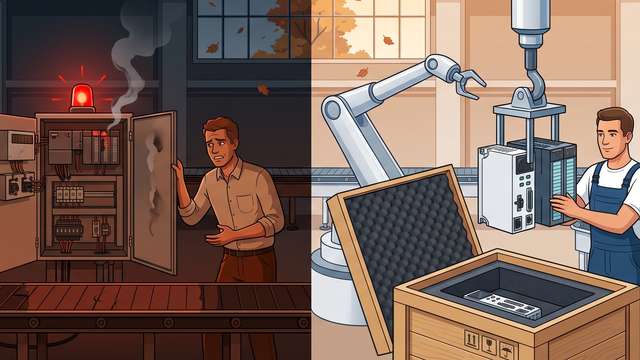

The global industrial sector faces a structural paradigm shift, with consequences impacting manufacturing facilities far faster than even the most skeptical industry analysts predicted. According to the latest data from the Association for Advancing Automation (A3) and reports published in Design News, the industrial market is confronting an unprecedented talent deficit - estimated at over 500,000 unfilled positions in technical roles, industrial automation, and plant maintenance alone. Compounded by the mass retirement of the Baby Boomer generation (the so-called Silver Tsunami), this trend lays bare an unforgiving reality: the era of cheap, unlimited access to highly qualified engineers and mechatronics specialists has definitively come to an end.
Table of content
1. Anatomy of a crisis: Why labor shortages directly impact OEE and production continuity
Traditional machine fleet management relied on a quiet assumption: whenever a failure occurred, the technical team would respond immediately, with ample time and bandwidth to conduct hours of complex troubleshooting. Today, that assumption is a dangerous illusion. A stark generational gap leaves maintenance departments operating under unprecedented pressure regarding both time and scope of work. Simultaneously, decades of accumulated domain expertise held by veteran automation engineers disappear as they retire, creating a severe competency gap.
The operational fallout is felt across every level of production:
- Extended mean time to repair (MTTR): Fewer technicians per shift means unplanned production line downtime lasts dramatically longer, with every single minute of delay directly translating into financial losses reaching tens or even hundreds of thousands of dollars.
- Cannibalization of preventive maintenance: Overburdened teams operate in constant "firefighting mode". There is simply no time left for scheduled predictive maintenance or key performance indicator (KPI) analysis, triggering a vicious cycle of recurring breakdowns.
- Risk of hasty modernization decisions: Under intense operational pressure, plant management often considers comprehensive, multi-million-dollar replacements of entire production lines - overlooking the fact that deploying new systems requires extensive staff retraining, for a workforce that is already stretched to its limit.
The single greatest threat to manufacturing plants is no longer a lack of orders, but the inability to fulfill them on time due to equipment failure - when there is nobody available to fix it, and no immediate replacement parts at hand.
2. The "Keep It Running" strategy vs. The illusion of full machinery modernization
Facing a persistent shortage of skilled talent, the definition of industrial modernization is shifting. Until recently, the default path to progress was the continuous upgrading of PLCs and drives to the latest product generations. Today, an increasing number of Chief Operating Officers recognize the trap in this mindset: new software, new communication protocols, and unfamiliar programming environments require specialized skill sets that existing staff rarely possess.
The response to this crisis is the "Keep It Running" strategy - an operational philosophy prioritized on maximizing efficiency and extending the service life of proven, currently operating production lines. Rather than undertaking costly, high-risk, and complex retrofits that cause extended downtime and demand reprograming from scratch, plants are focusing on Plug & Play solutions to rapidly restore mechanical and electronic functionality.
The core pillar of this strategy is the direct, like-for-like replacement of faulty components - such as servomotors, I/O modules, HMI panels, or PLC controllers - with identical hardware, even if those parts are officially designated as obsolete or discontinued by the OEM. By eliminating the need to modify source code or alter control cabinet wiring, replacement time drops from days to mere minutes. This approach removes reliance on expensive external programming consultants and shields overburdened internal maintenance teams from immense pressure.
3. A Strategic partner in uncertain times: How Automation Trader secures operational continuity
The ultimate success of the "Keep It Running" strategy hinges on a single crucial factor: the availability and reliability of a dependable spare parts supplier. When a line halts and the plant's internal inventory lacks the required module, traditional OEM supply chains often fail, offering lead times measured in weeks or months. In a labor-constrained environment, no plant can afford such exposure.
This is where experienced, specialized business partners become vital. Automation Trader has long established itself as a critical link in safeguarding production continuity for industrial facilities across Europe and beyond. In today's talent crisis, Automation Trader's support acts as an essential insurance policy for maintenance departments.
Why partnering with Automation Trader is a decisive advantage in uncertain markets:
- Vast In-Stock Spare Parts Inventory: An extensive warehouse offering tens of thousands of components immediately available off the shelf - ranging from current production lines to legacy and obsolete items discontinued by major manufacturers (Siemens, Allen-Bradley, Omron, Fanuc, Yaskawa, and many others).
- End-to-End Solutions - From Repair to Replacement: Automation Trader is more than a parts distributor; it is a full-service partner providing professional repairs, component refurbishment, and load-tested refurbished parts that undergo rigorous quality verification prior to dispatch.
- Maximizing Internal Team Efficiency: Through rapid order fulfillment and comprehensive warranties on supplied hardware, your plant's engineers can remain focused on core operational tasks rather than wasting hours hunting down components across unverified markets.
- Transaction Security and Trust: Amid volatile global supply chains and a rising number of unverified brokers, Automation Trader guarantees 100% functional readiness, backed by solid warranties and dedicated technical support.
The workforce deficit in industrial automation is not a temporary disruption - it represents a permanent shift in the industrial labor landscape. In the race for profitability, the winning facilities will be those that empower their existing teams through proven hardware, operational simplicity, and reliable partners equipped for emergency response. Protect your plant's production continuity today - explore the inventory at Automation Trader and discover how quickly we can restore your lines to full operation.